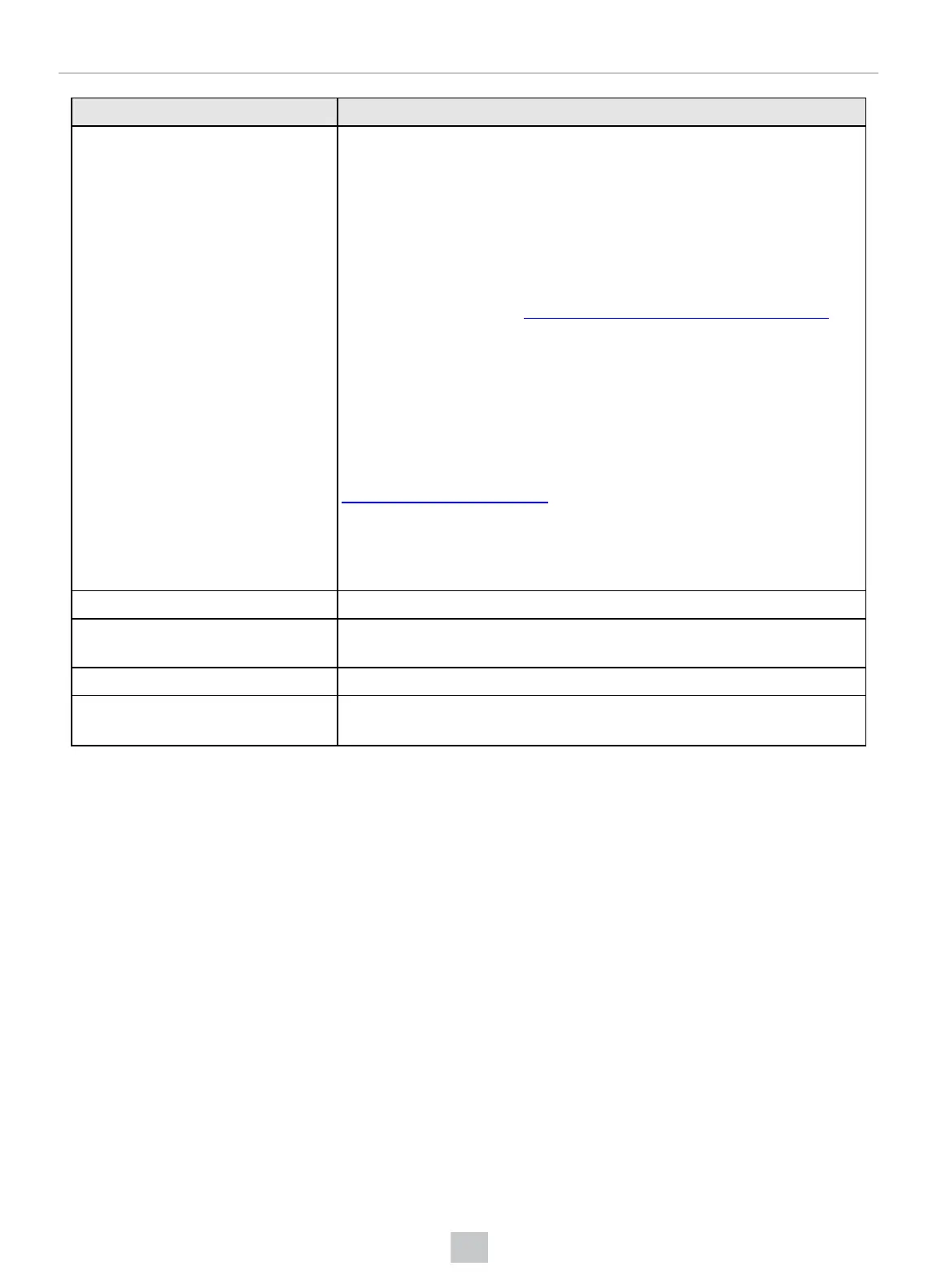
Parameter Description
Tilt, pitch, rotation, and package
spacing
The degree to which a code may be rotated, tilted, or pitched with respect to a
plane perpendicular to the DataMan optical axis.
Package spacing means a distance in time. If you use a conveyor that moves
very fast, you need more space between the boxes. If it moves very slow, you
need less space. In general, the minimum time distance between boxes must
be greater than the distance between trigger on and trigger off.
Tilt and pitch should be limited to 15-20 degrees in most cases, while rotation
may be absent or may occur up to 360 degrees (omnidirectional reading).
As described in the section Reducing DataMan Processing Requirements, the
more information that you can provide to DataMan about your application, the
less work – and processing time – will be required to decode symbols.
l Only enable the symbologies that your application uses. Disabling
unused symbologies reduces processing time.
l Train codes.
l Only enable extended mode decoding if your application requires it.
Avoiding Reflections and Glare, you should mount the reader so that the
surface containing the code to be read is not perpendicular to the reader. If
your application includes tilt or pitch, make sure that the reader is mounted so
that even at maximum tilt or pitch, the reader still is angled with respect to the
surface being read.
Code module size The size of a code element (typically the smallest bar) in Mils.
Codes per minute The maximum number of codes that pass in front of the reader location per
minute.
Codes per image The number of codes visible at the same time.
Trigger and output signal requirements Whether an external trigger signal is available or a discrete output signal is
required.
The following sections describe typical application envelopes for typical DataMan code reading applications, along with
suggested configuration values.
Tote Scanning
Tote scanning applications typically involve reading a single barcode that is relatively well-fixtured.
167
Application Guide



 To Next Page