Alarms
72
Instructions for Use Infinity Acute Care System - Monitoring Applications SW VG1
Overview of Alarms
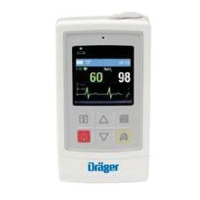
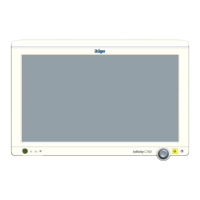
The Cockpit and the M540 produce audible and
visual alarm signals to alert you to alarm conditions
ranging from alarm limit violations, arrhythmia calls,
and network issues.
Each alarm condition is assigned one of three
alarm priorities: high (life-threatening), medium
(serious), and low (advisory). Each alarm priority
has unique audible and visual alarm signals.
In addition to the visual and audible alarm signals,
alarm messages appear in the header bar of the
Cockpit and in the alarm message field of the
M540. For some parameters, such as NIBP and
SpO
2, certain alarm messages are displayed in the
parameter box of the Cockpit only. All alarm
conditions and associated alarm messages are
described in detail in the ’Problem Solving’ chapter
starting on page 325.
The colour of an alarm message corresponds to the
priority of the associated alarm condition (see
"Alarm Priorities" on page 73).
Physiological alarms for a patient can be set up to
generate automatic recordings and/or store alarms
for later event review in the alarm history.
Furthermore, a physiological alarm can also
activate an external alarm device such as a nurse
call system. Special monitoring modes (see
page 80), such as cardiac bypass mode, affect the
regular alarming behaviour.
When connected to the Infinity network, the Cockpit
and the M540 can be configured to report alarm
conditions occurring at other monitors that are also
connected to the Infinity network.
For detailed instructions regarding the alarm
functions of the M540, refer to the Infinity Acute
Care System - M540 Instructions for Use.



 To Next Page