Instructions for Use Infinity Acute Care System - Monitoring Applications SW VG1 73
Alarms
Alarm Priorities
Each alarm condition is assigned to one of three
priorities: high (life-threatening), medium (serious)
or low (advisory). Visual and audible alarm signals
indicate the level of the alarm priority. For more
information on how alarm priorities affect alarm
reporting, see "Visual Alarm Signals" on page 76
and "Audible Alarm Signals" on page 78.
High-Priority Alarm Conditions
All high-priority alarms are physiological alarm
conditions that can be life-threatening and require
immediate intervention.
An example of a high-priority alarm condition is
asystole.
Medium-Priority Alarm Conditions
Most medium-priority alarms report physiological
alarm conditions, that require prompt attention but
may not be life-threatening.
An example of a medium-priority alarm condition is
a respiratory-rate limit violation.
Low-Priority Alarm Conditions
All low-priority alarms alert you to technical issues
that may compromise the ability of the system to
monitor the patient.
An example of a low-priority alarm condition is an
artefact on the ECG waveform.
Alarm Processing
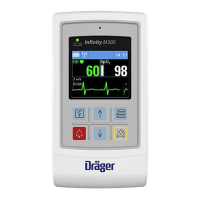
When you dock an M540 on the M500 (see
page 59), all visual and audible alarm signals are
automatically transferred to the Cockpit. Audible
alarm signals only sound at the Cockpit not at the
M540 by default. If you also want alarms to sound
at the M540 when it is docked, select the alarm tone
volume at the M540 manually (refer to the Infinity
Acute Care System - M540 Instructions for Use).
The Cockpit provides audible and visual alarm
signals for parameters originating from monitors in
its alarm group (see page 99). In addition, the
Cockpit reports technical alarms affecting the
Infinity network.
When you undock the M540 from the M500 (see
page 59), all alarm monitoring stops at the Cockpit
but continues on the M540.
NOTE
Alarm monitoring is not available for the following
parameters: cardiac output (C.O.), injectate
temperature (Tinj), pulmonary wedge pressure
(PWP), paced beats (% Paced), perfusion index
(PI) for the Masimo SET MCable, any parameter
displayed on the Cockpit using the device
connectivity option.



 To Next Page