58 Filter Envelope
Groove Synthesis
sound. Sonically that would be pretty boring. It’s also not how instru-
ments behave in the real world. In general, sounds produced by an
instrument are brighter at their beginning (the attack stage) and grow
mellower as they die out (the decay and release stages). In other words,
their harmonic content changes over time. This is what the lter envelope
is designed to emulate.
AMP ENVELOPE
FILTER ENVELOPE
ATTACK DECAY SUSTAIN RELEASE
ATTACK DECAY SUSTAIN RELEASE
Filter Envelope
attack
decay
sustain
release
amplitude
time
note offnote on
delay
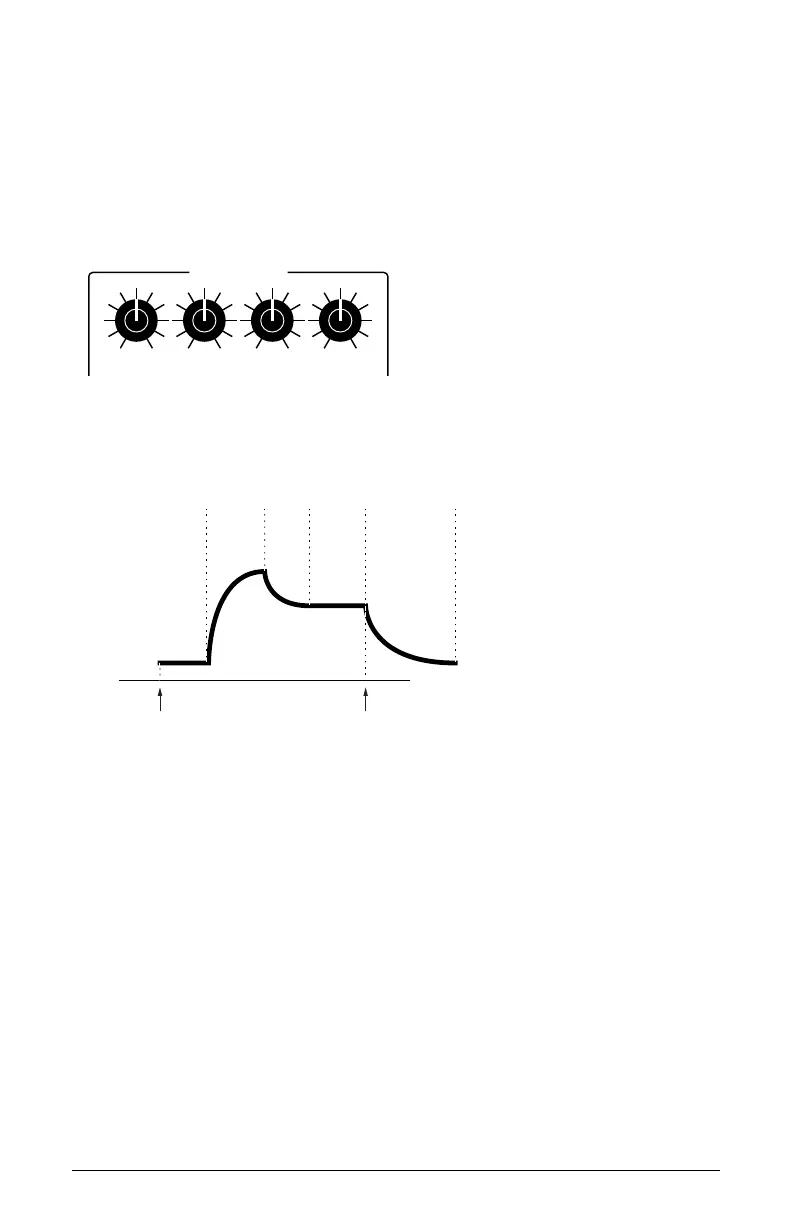
A typical 4-stage ADSR envelope
Filter Envelope Controls
ATTACK: (0-127) Sets the attack time of the envelope. The higher the
setting, the slower the attack time and the longer it takes for the lter to
open from the level set with the lter cutoff knob to the level set by the
lter envelope amount. Percussive sounds typically have sharp (short)
attacks.
DECAY: (0-127) Sets the decay time of the envelope. After a sound reaches
the lter frequency set at its attack stage, decay controls how quickly the
lter then transitions to the cutoff frequency set with the sustain knob.
The higher the setting, the longer the decay. Percussive sounds, such
as synth bass, typically have shorter decays (and some low-pass lter
resonance).



 To Next Page