54 MIDI
Hammond XK-2 Quick Features Guide
MIDI
The letters MIDI stand for Musical Instrument Digital Interface. MIDI is an international standard for allowing electronic
musical instruments equipped with MIDI capability to exchange performance information. For example, a synthesizer can be
used to communicate with a drum machine, an electronic piano can interface with a computer, and so forth. Additionally,
since MIDI is an international standard recognized and implemented by all musical instrument manufacturers worldwide,
instruments made by different manufacturers can communicate with each other via MIDI.
MIDI Connections
Ë MIDI IN and MIDI OUT
In order to allow communication to take place, all MIDI-equipped instruments have at least two MIDI jacks - MIDI IN and
MIDI OUT. MIDI IN is for receiving MIDI data from another instrument, while MIDI OUT is for sending MIDI data
out to another instrument.
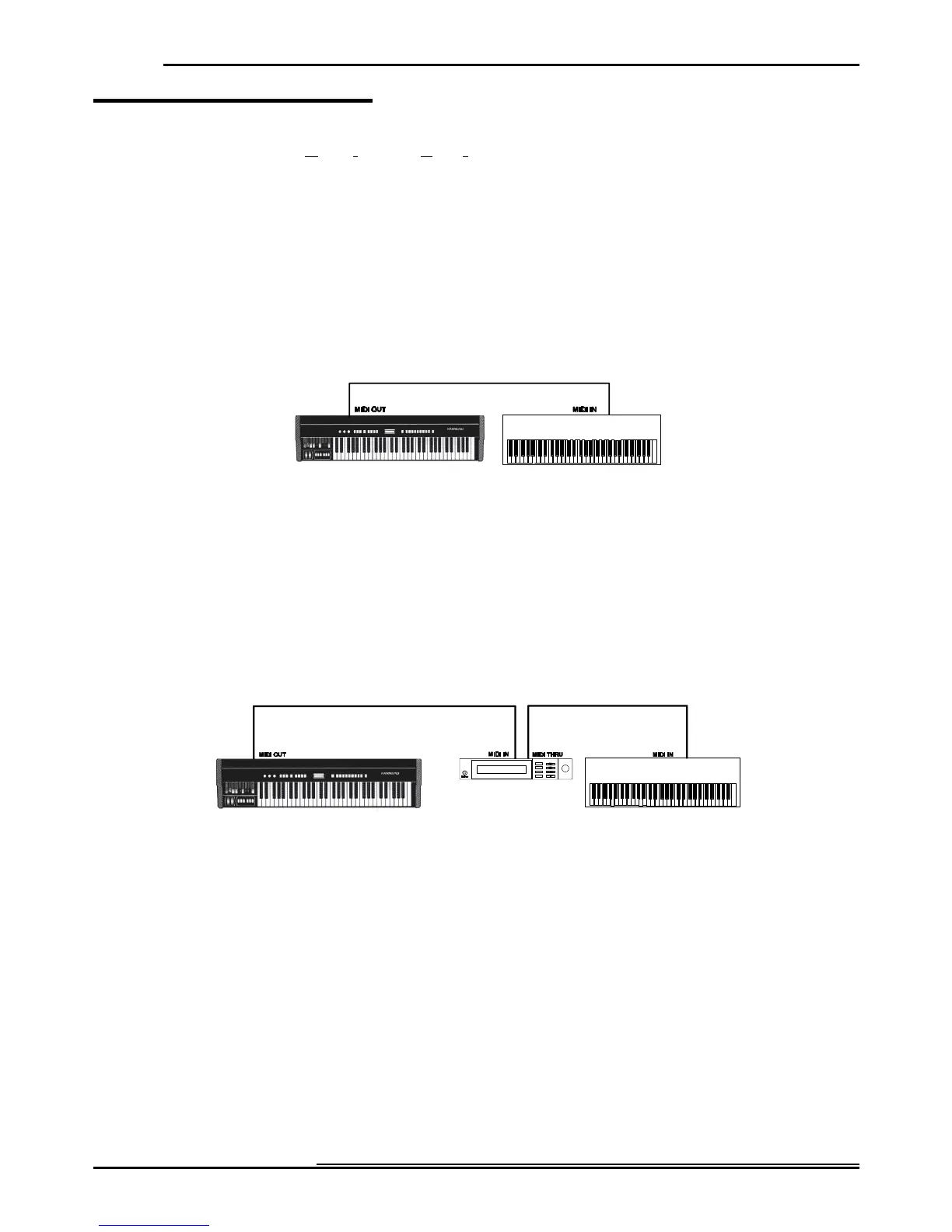
In the example above, the keyboard of the sending or transmitting instrument (MIDI OUT) is being used to control the
sound generators of the receiving instrument (MIDI IN). When a key is played on the sending instrument, the
corresponding note will play on the receiving instrument. When the key is released on the sending instrument, the tone being
played by the receiving instrument will stop. (This is called "Note On / Note Off" data and is the most basic MIDI hookup.)
Ë MIDI THRU
The MIDI THRU function allows more than one instrument to be controlled by the same transmitting instrument - in other
words, the data being sent from MIDI OUT goes to MIDI IN, where it can be passed on to another instrument via MIDI
THRU. The picture shown below shows how this is done.
In the above example, the MIDI data goes from the sending instrument (MIDI OUT) to another instrument (MIDI IN),
which receives the data and passes it along to a third instrument via the MIDI THRU connection.


 To Next Page