2011-07-01/00561073 [SCR Power Controller TYA202] 57
5 Configuration
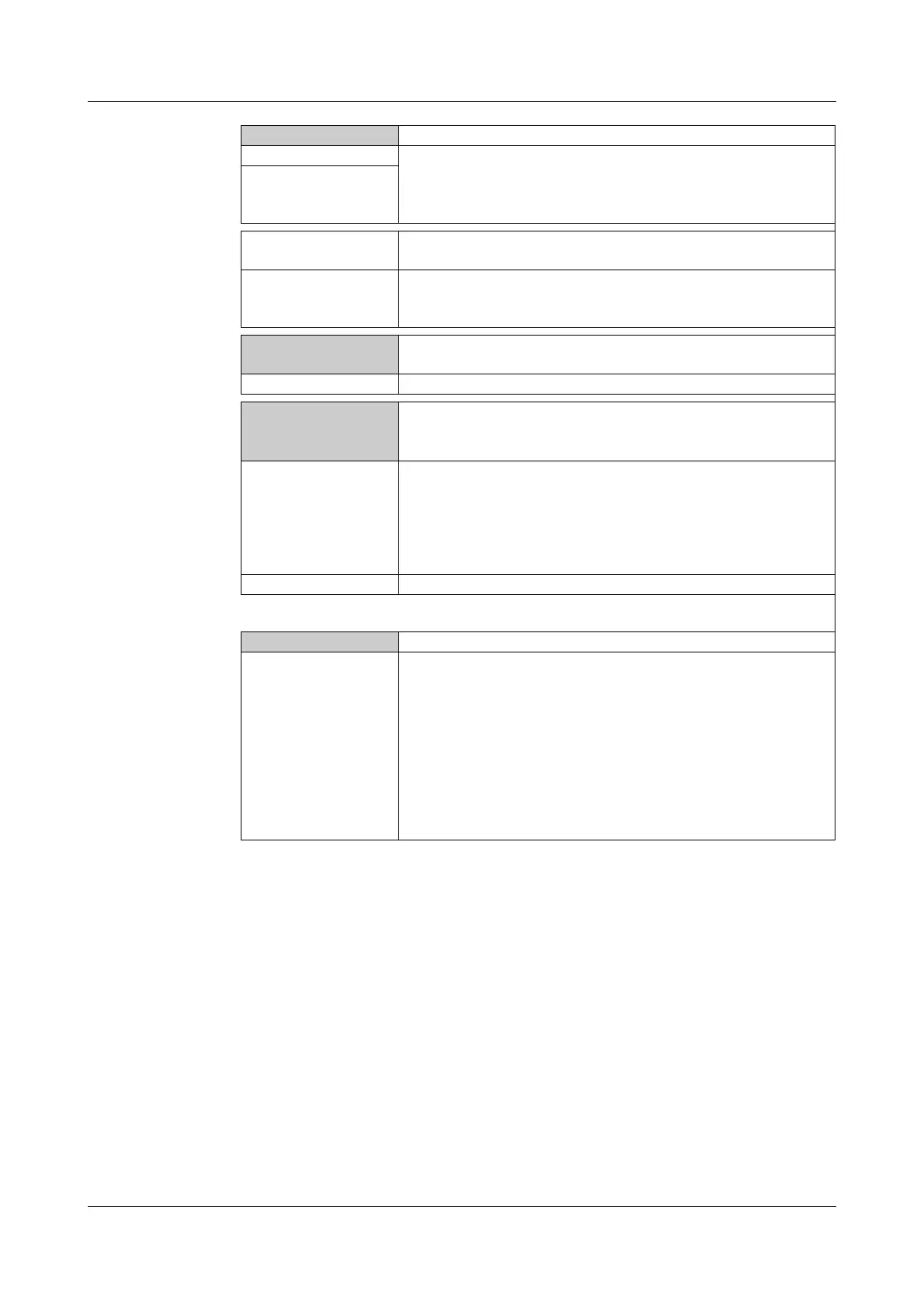
Load monitoring None The load is not monitored.
Undercurrent
Note: This parameter is only available if the device type is
equipped with a cascade control I, I
2
or P, permitting measure-
ment of the current.
v Chapter 6.1 „Detection of load faults“
Overcurrent
Note: This setting is only available if load monitoring for un-
dercurrent or overcurrent has been set.
Limit value, load
monitoring
0...10 ... 100% This setting is used to specify the percentage by which the
load current has to have decreased or increased to trigger a
load fault.
Load type, load
monitoring
Standard Standard setting (suitable for most load types)
Infrared radiators
Specifically suitable for short-wave infrared radiators
Teach-in type, load
monitoring
automatic (once) The teach-in value is automatically determined once after
each power ON.
v Chapter 6.1.1 „Teach-In“
Manual Teach-in can be performed in manual mode or at the operator
level.
v Chapter 6.2.2 „Configuring the teach-in (prerequisite
for teach-in in manual mode)“
v Chapter 4.2.4 „Monitoring“
Automatic (cyclically) Teach-in is cyclically performed at a time interval of 1 minute.
Monitoring of the
supply voltage drop
no no monitoring
yes
If the effective values of the analyzed half-waves diverge from
each other by more than 10%, an alarm message is displayed
and the binary output for multi-input fault warning is switched
depending on the set control direction.
Immediate firing-pulse inhibit prevents connected transformer
loads from destroying the semi-conductor fuse due to a DC
component.
If there are no more supply voltage drops, the firing-pulse in-
hibit is canceled and the power controller continues operation
e.g. with a soft start.
k/ bold = factory setting


 To Next Page