2011-07-01/00561073 [SCR Power Controller TYA202] 73
6 Special device functions
6.5 Cascade control
Cascade control loops are used to eliminate or compensate for external
interference, such as fluctuations in the supply voltage and changes in
resistance which would have a negative effect on the control loop.
6.5.1 Closed control loop without cascade control
Example
Furnace/kiln
control system
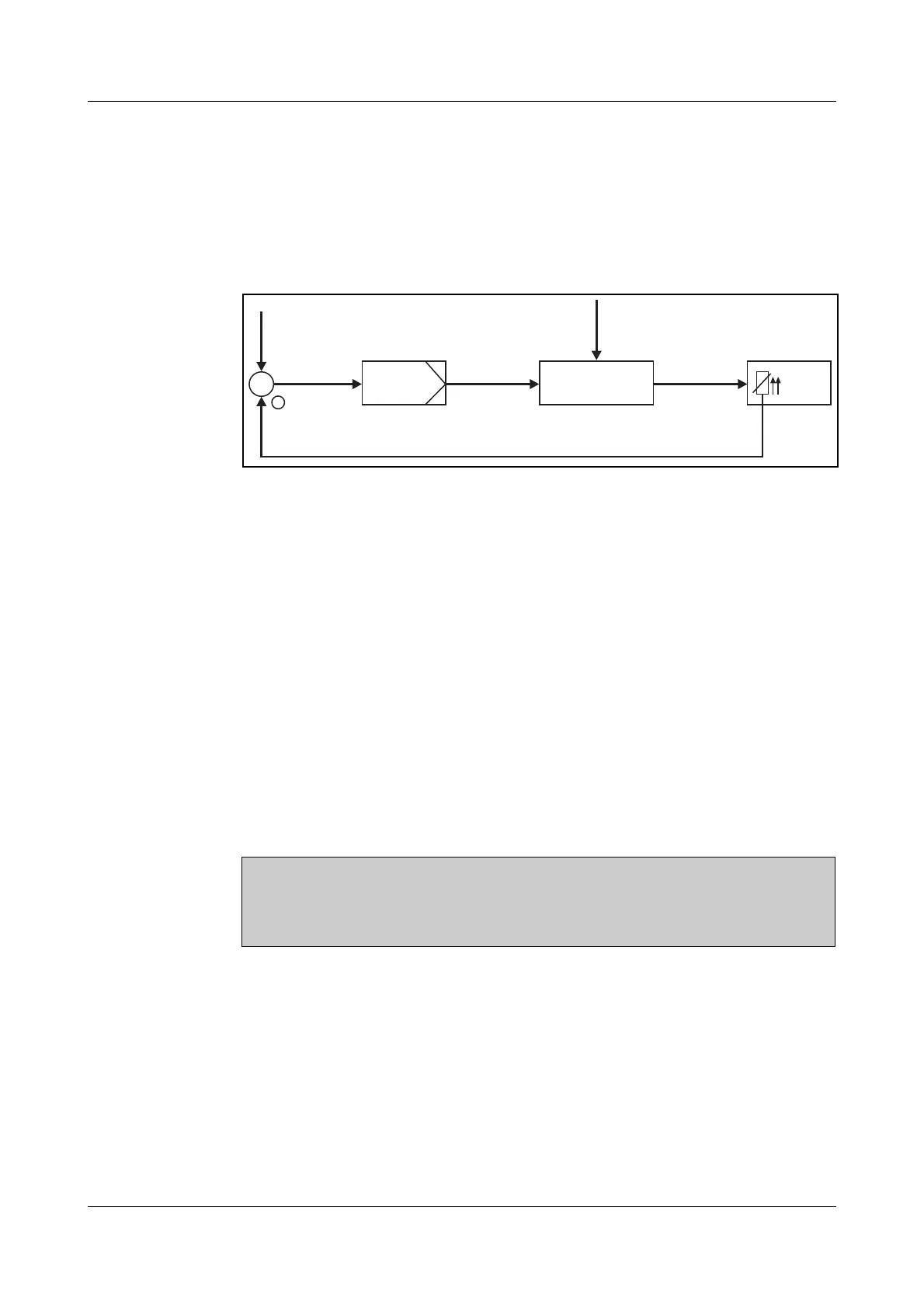
The supply voltage is connected to the power controller. The controller derives
the output level y
R
from the difference between the set value (w) for the
furnace temperature and the actual (or process) value (x) which is acquired by
a sensor inside the furnace. The output level can vary over the range 0 ... 100
% and is produced as a standard signal output, e.g.0 ... 10 V. The output level
signal is fed to the power controller.
The task of the power controller is to feed energy to the heating elements in
the furnace, proportional to the controller output level:
- For an SCR power controller using phase-angle control, this means that
it alters the firing angle over the range from 180° to 0°, corresponding to a
controller output level of 0 ... 100 %.
-If the SCR power controller is using the burst-firing mode, it alters the
duty cycle T from 0 ... 100 % to correspond to the controller output level of
0 ... 100 %.
If the supply voltage drops from AC 230V to AC 207V (-10%) at a controller
output level YR, the power fed to the furnace is reduced by 19%.
P230V : Power in the load resistance at a supply voltage U of 230V
DP: Power reduction resulting from reduced supply voltage
R: Resistance of the load
This 19% reduction in the energy being fed means that
the furnace temperature falls.
Disadvantage: A continuing constant temperature is no longer assured.
Controller
Furnace
Sensor
SCR
power unit
Supply
voltage
y
R
x
y
-
w
(2)
P
230V
P–
U0–
·
1U
2
R
-------------------------------
09U
2
R
-------------------- - 0,81 P
230 V
===


 To Next Page