Measuring distortion
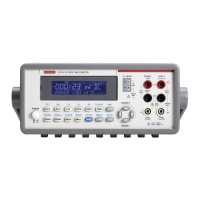
The Model 2016 can make distortion measurements from 0.002% to 100% (-94dB to 0dB).
The 2016 uses a digital signal processor (DSP) to perform a fast Fourier transform on the signal
applied to the front or rear voltage inputs. It then analyzes the levels of the harmonics present in
the signal to calculate THD, THD+noise, and SINAD. A direct digital synthesis module
included in the distortion circuitry provides a programmable sine source. The source has a
second output that can provide the inverse of the sine output (shifted 180˚), or output 0-5V logic
level pulses in phase with the main output. Distortion measurement types are explained below:
• THD — Total harmonic distortion is the default distortion measurement type. It is
expressed in percent or dB. The measurement is calculated as follows:
where h
i
is magnitude of the i
th
harmonic and f is the magnitude of the fundamental
waveform.
• THD+n — This is total harmonic distortion plus noise. It is what conventional (analog)
THD meters display. A conventional THD meter has a notch filter that removes the
fundamental frequency from the signal, and measures THD based on what remains. This
includes all of the harmonics, but also includes any random noise in the signal. Since the
Model 2016 uses a DSP to perform a Fourier transform on the signal, noise can be
eliminated from the distortion measurement, thus providing a true reading. This
measurement is expressed in percent or dB, and is calculated as follows:
where h is the harmonic, n is the noise, and f is the magnitude of the fundamental waveform.
• SINAD — This is another way of expressing THD+noise. It is the RMS magnitude of
the signal divided by the RMS magnitude of the difference between the signal and the
fundamental. This measurement is expressed only in dB. The calculation is as follows:
where h is the harmonic, n is the noise, and f is the magnitude of the fundamental waveform.
The digital averaging filter (moving or repeating) can be used with distortion measurements.
The RATE key has no effect on distortion measurements, because there is no NPLC setting.
NOTE The Rel key is not supported for distortion measurements.
h
2
2
h
2
3
h
2
4
… h
2
i
++ +
f
-------------------------------------------------------------------
h
2
2
h
2
3
h
2
4
… h
2
1024
n++ + +
f
-----------------------------------------------------------------------------------
h
2
2
h
2
3
h
2
4
… h
2
1024
n
2
f
2
++ + ++
h
2
2
h
2
3
h
2
4
… h
2
1024
n
2
++ + +
--------------------------------------------------------------------------------------------------------
2-34 Basic Measurements


 To Next Page