CHAPTER 4: OPERATION 51
MOVE S2
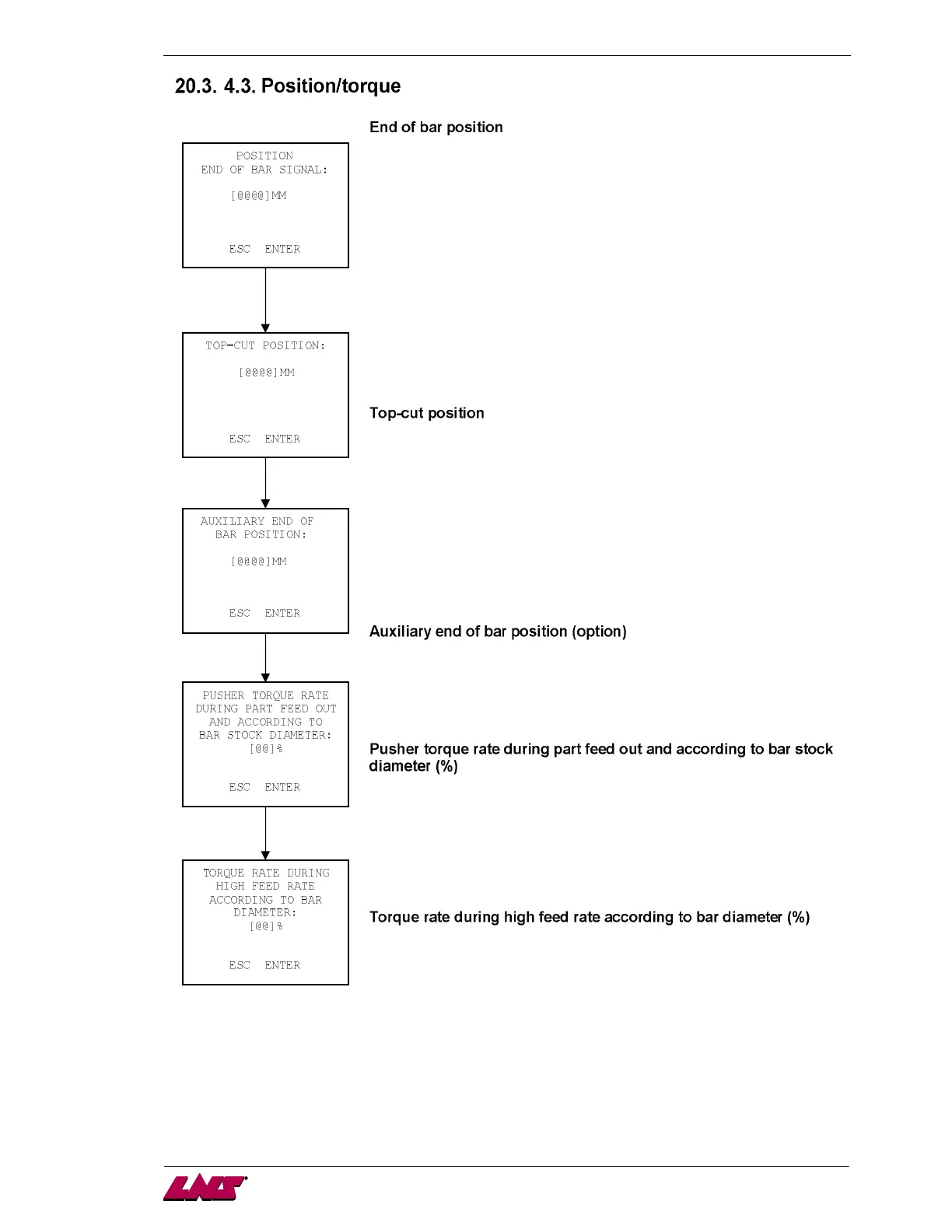
The end of bar position determines the moment when the bar feed
enters the loading cycle.
Usually, the end of bar position is adjusted as closely as possible behind
the clamping system of the lathe (approximately 5 mm or a 1/4" behind
the chuck jaws or collet pads).This will provide minimum bar stock
remnant.
Regardless of the length of the bars, or parts, the end of bar position is
always the same. In very special cases, a different end of bar setting
needs to be selected.
Refer to the Start-up manual for the settings.
During the loading cycle, the bar is automatically loaded and positioned
into the spindle, outside the clamping device of the lathe (chuck or
actuator).
This positioning corresponds to a value (Z) programmed by the operator,
which is equal to the distance between the measuring cell and the
position of the material in the lathe clamping device.
With this system, the setting is the same for any bar length. Further
information in the startup manual.
Depending on the lathe and its options, the auxiliary end of bar may be
used in several ways, for example for the opening of an external rest.
The procedure is the same as this for the end of bar setting.
Depending on the diameter of the bar, the bar feeder will automatically
select an appropriate pushing torque and speed. The operator may
modify this selection if necessary. When the material to be loaded has a
high specific weight, the torque must be significant. The contrary applies
if the specific weight of the bars is low.
Depending on the diameter of the bar, the bar feeder will automatically
select an appropriate pushing torque and speed. The operator may
modify this selection if necessary. When the material to be loaded has a
high specific weight, the torque must be significant. The contrary applies
if the specific weight of the bars is low.



 To Next Page