starting recur during the hold time period then the time of the renewed starting
will be added to the time period stored. When the starting times sum reach the
tripping time value determined by the P631 then the corresponding signal will be
issued. Should starting not recur during the hold time period then, depending on
the setting, the memory storing the accumulated starting times value will either
be cleared without delay or according to the characteristic set. In Fig. 3-106,
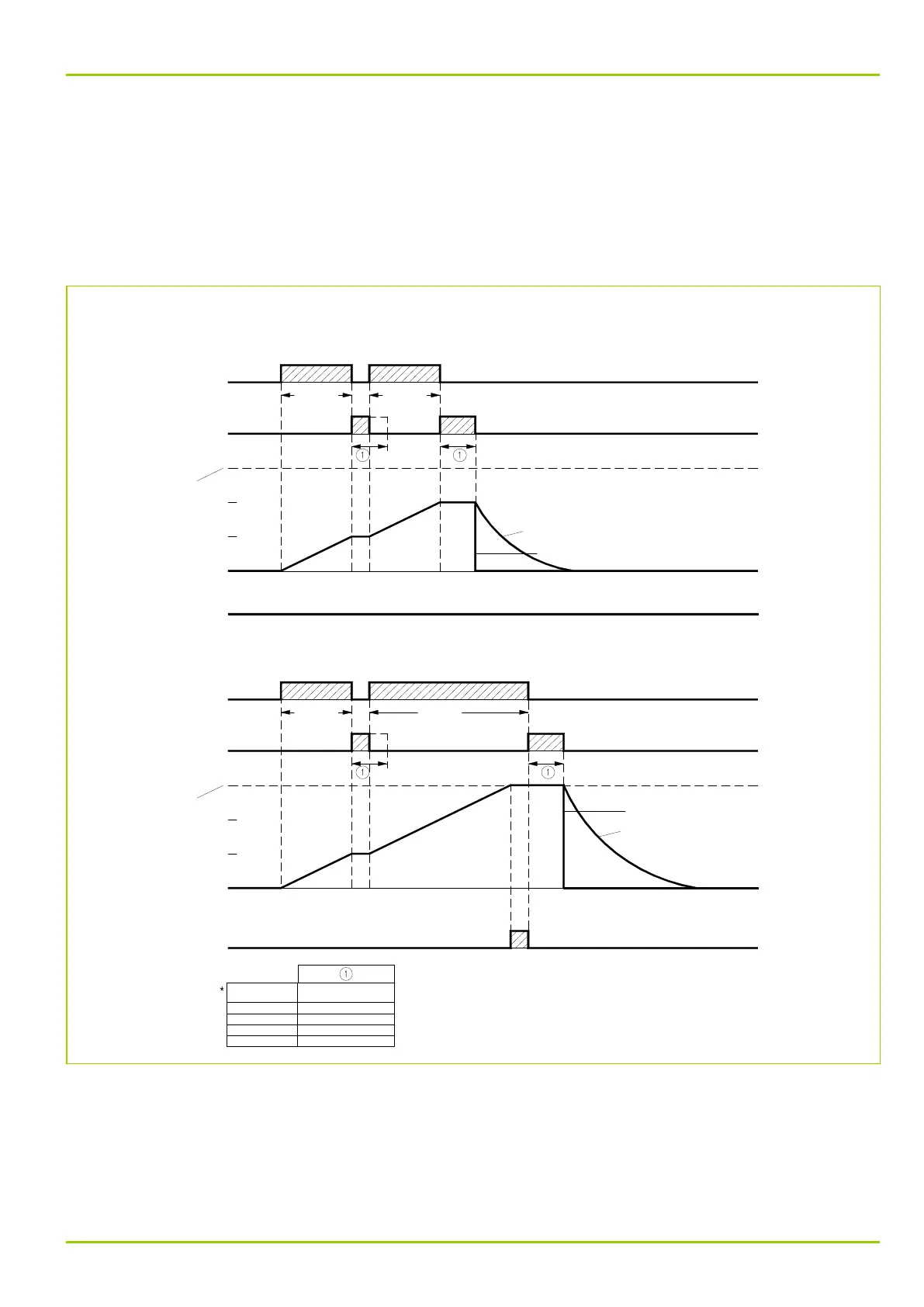
(p. 3-143), the effect of the hold time is shown by the example of a phase
current stage.
Q6Z0131A
Parameter
set 1
set 2
set 3
set 4
IDMT1:
Hold time P PSx
081 055
082 055
083 055
084 055
IDMT1:
Starting Iref,P>
[ 038 110 ]
Case A
Case B
Per characteristic
Non-delayed
Non-delayed
Per characteristic
Determ. trip time
IDMT1:
Hold time P running
[ 038 112 ]
IDMT1:
Starting Iref,P>
[ 038 110 ]
IDMT1:
Hold time P running
[ 038 112 ]
600 ms
400 ms
200 ms
IDMT1:
tIref,P> elapsed
[ 038 111 ]
Determ. trip time
600 ms
400 ms
200 ms
IDMT1:
tIref,P> elapsed
[ 038 111 ]
200 ms 200 ms
200 ms 450 ms
Fig. 3-106: The effect of the hold time illustrated for the phase current stage as an example
Case A: The determined tripping time is not reached.
Case B: The determined tripping time is reached.
3 Operation
P631
P631/EN M/R-11-C // P631-310-650 3-143


 To Next Page