Spot Size and Resolution 5.4.3
All laser measurement systems have constrained operational limits due to the methods and materials
employed. Two such constraints exist in BeamSquared due to the size of the imager and pixel dimensions in
use.
1.
Large Spot Size – Including frames with beam sizes that exceed 2/3 of the imager may
decrease the accuracy of the beam propagation measurement. If the beam does cover 2/3
of the imager, BeamSquared will alert you the beam is too big and that including the frame
in the measurement may degrade accuracy. Centered alignment of the beam is also critical.
2.
Small Spot Size – Conversely, due to the pixel size, a small beam causes an even greater
challenge. Experience has shown that measuring a beam less than 10 pixels wide in either
the X or Y direction yields unsuitable results. BeamSquared will not prevent you from
making such measurements, but the resulting accuracy will be degraded.
For information concerning the Pyrocam IV and IIIHR, see section 9.2.
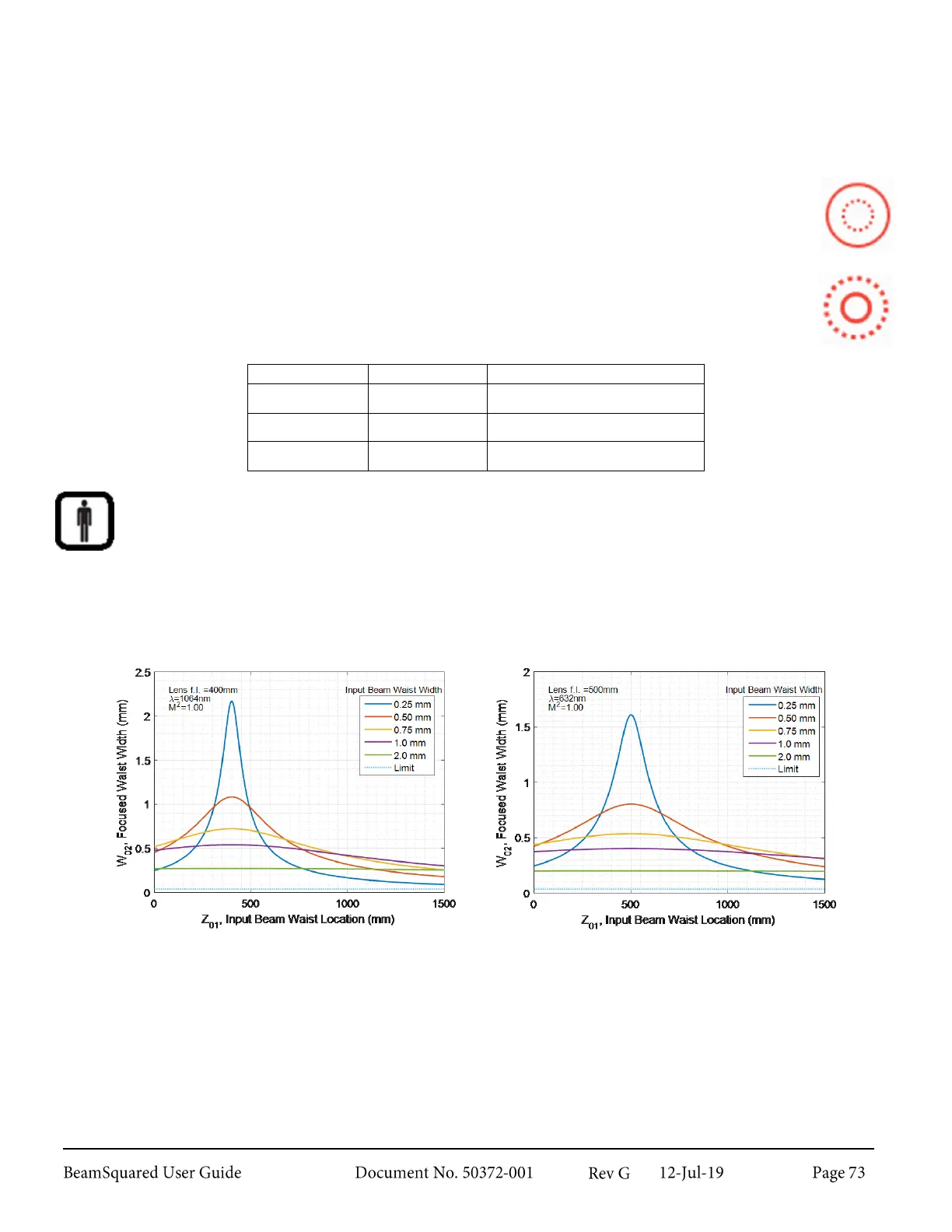
The following figures show how the beam width of the focused input laser changes under a range of different
conditions. In this image, the focused spot size is plotted against the input waist location for a variety of input
beam sizes shown representing only M
2
= 1.


 To Next Page