First steps
32 FP Web-Server V2.810 EN
Chapter 3
First steps
3.1 Getting started
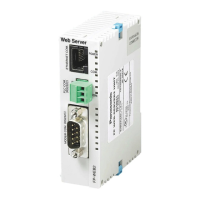
This section describes putting the FP Web-Server into operation for the first
time. The subsequent step-by-step example depicts the general
configuration and use of the FP Web-Server for displaying HTML pages.
Refer to the e-mail function of the FP Web-Server (see p. 47) for an easy start.
For details on programming e-mail support on the PLC, refer to the
PEW_FPWEB library and its online help.
For further information, refer to Ethernet/serial (RS232C, RS485, USB) ports
(see p. 123).
3.2 The Ethernet network
The FP Web-Server is supplied with a 10/100BaseT Ethernet connection.
This type of Ethernet network uses a peer-to-peer connection with twisted
pair cables. To establish a network, hubs and switches are used to connect
the participants in a star-shaped manner.
To be able to configure the FP Web-Server, a Windows computer with an
Ethernet network interface card has to be connected to the same network
as the FP Web-Server. The FP Web-Server can be connected to an existing
Ethernet network.
It is also possible to set up a separate network for the FP Web-Server. The
computer can also be directly connected to the FP Web-Server by using a
special "cross-over" Ethernet cable (see p. 181).
3.3 Connection of the FP Web-Server
For an initial function test (without the PLC data), the FP Web-Server has
to be connected to the Ethernet and be supplied with operating voltage
(24V DC and FG).





 To Next Page