Modbus functions
FP Web-Server V2.810 EN 157
Chapter 17
Modbus functions
17.1 Overview over Modbus-TCP functions of the FP Web-Server
General information on Modbus-TCP
The Modbus-TCP is a standard global communication protocol (IAONA,
Modbus-IDA) and is used to connect the PLC to third-party PLC
equipment, SCADA systems, OPC servers, and Modbus RTU gateways.
A Modbus-TCP server waits for an incoming connect from a Modbus-TCP
client. Hence:
A Modbus-TCP server (Ethernet) is comparable to a Modbus RTU slave
(serial).
A Modbus-TCP client (Ethernet) is comparable to a Modbus RTU master
(serial).
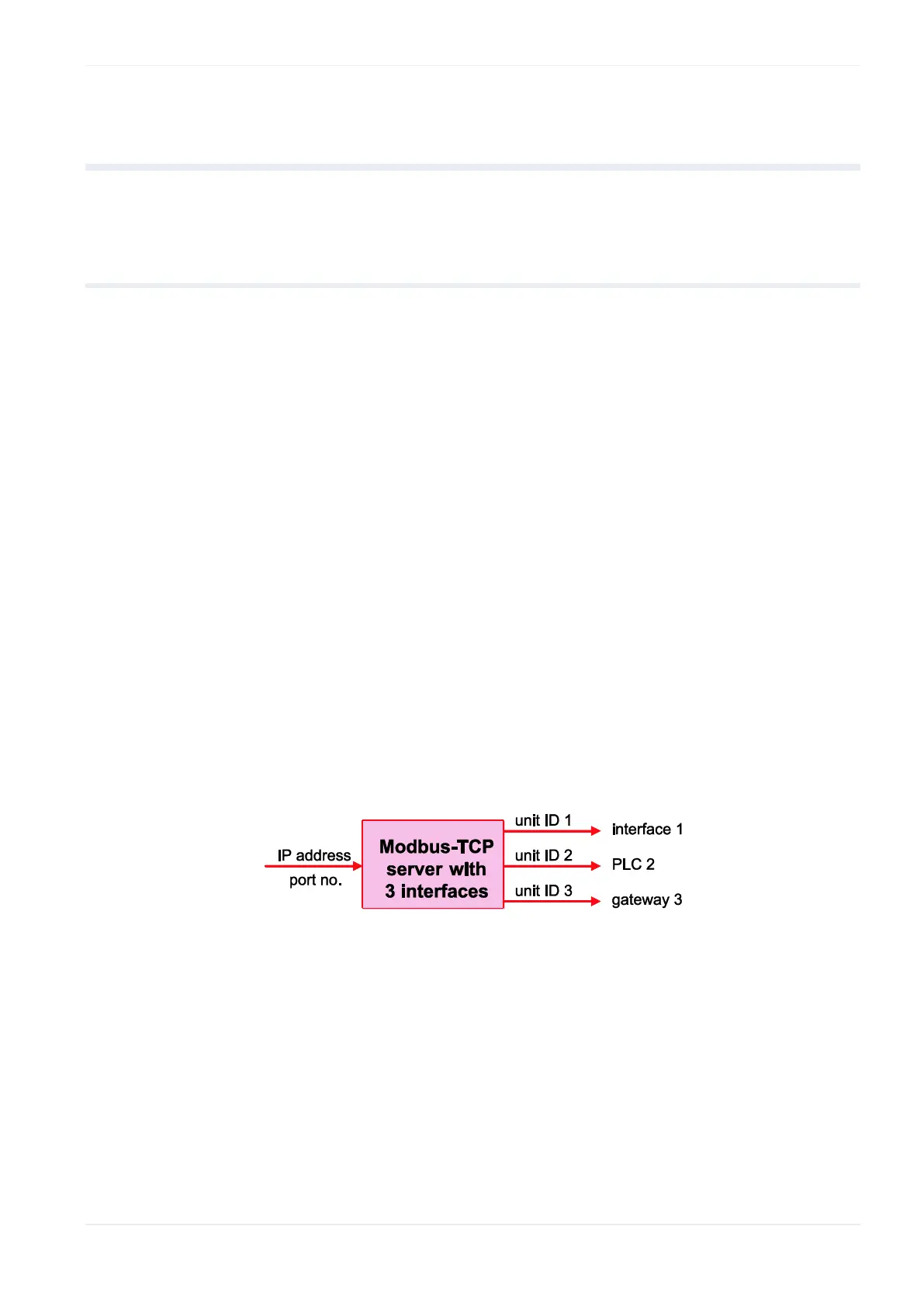
A Modbus-TCP server is addressed with a unique IP address and a port
number (default 502). Using a unit ID address in the Modbus-TCP data
packet, various interfaces of the Modbus-TCP server can be addressed. The
unit ID is comparable to the slave address in Modbus RTU communication.
Modbus communication is based on a number of specified function codes
which can address different data types. Which function codes and data
types are supported depends on the unit implementation.
FP Web-Server specific implementation
The FP Web Configurator Tool allows you to configure the FP Web-Server
(as an interface to the PLC) with the following Modbus-TCP server and
client functions.





 To Next Page