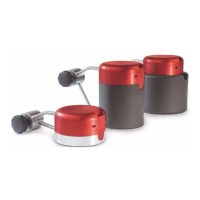
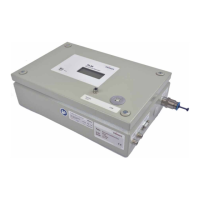
The PowerMeasuringModule (PMM) is a device designed for analyzing laser beams, specifically for high-power CO2, fiber, solid-state, and diode lasers. It covers a wide wavelength range from infrared to near UV, enabling the determination of various beam parameters such as laser power, beam dimensions and position (unfocused and focused), and beam quality factor M². The device operates without cooling water or compressed air, relying on thermal conduction to the ambient air for cooling its absorber.
Function Description
The PMM measures laser power using a calorimetric principle. When the shutter opens, the laser beam strikes an absorber, and scattered light is registered by a photodiode. Both the absorber and the photodiode are protected from contamination by a transparent protective window. The shutter and port caps further shield the PMM from contamination, allowing its use directly in production environments.
The measurement process involves briefly irradiating the absorber with the laser beam. The irradiated energy is determined by the temperature rise of the absorber. Simultaneously, the photodiode measures the laser on-time. A high-frequency sampling rate of the photodiode allows for single pulse detection for pulses as short as 50 µs. This enables the calculation of both average and peak power. The actual laser power is then derived from the absorbed energy divided by the laser on-time.
The PMM can be integrated into nearly any existing machine due to its various fieldbus interfaces, including PROFINET®, PROFIBUS®, Parallel, DeviceNet™, EtherNet/IP™, and EtherCAT®. Measurement results are directly transferred to the PLC.
Important Technical Specifications
The PMM is available in different configurations, distinguished by interface, absorber type (standard or advanced), capability to measure pulsed lasers, reduced thermalization time, and measurable wavelength range. Some devices also carry UL marking.
- Power Range:
- Standard absorber: 400 – 6,000 W
- Advanced absorber: 400 – 12,000 W
- Wavelength Range:
- BG (Blue/Green): 440 – 460 nm / 510 – 540 nm
- NIR (Near Infrared): 800 – 1,100 nm
- Max. Beam Diameter: 30 mm
- Max. Power Density on Absorber (approx. 25 mm below top edge of device with shutter open):
-
10 mm beam diameter: Standard 1.5 kW/cm², Advanced 4 kW/cm²
- 10 – 3 mm beam diameter: Standard 2.5 kW/cm², Advanced 5 kW/cm²
- 3 – 1.5 mm beam diameter: Standard 5 kW/cm², Advanced 10 kW/cm²
- < 1.5 mm beam diameter: Standard 6 kW/cm², Advanced 12 kW/cm²
- Irradiation Time: 0.1 – 2.0 s (standard), 0.1 – 1.0 s (AP3s type for pulsed lasers)
- Min. Ontime/Offtime (Duty Cycle) for Pulsed Lasers: 50 µs (e.g., max. 10 kHz at 50% duty cycle)
- Max. Laser Rise Time: < 1% of irradiation time
- Energy per Measurement: 400 – 3,500 J
- Recommended Energy per Measurement: 400 – 1,000 J
- Total Duration until Measurement Value Output: < 15 s (standard), < 5 s (AP3s type with reduced thermalization time)
- Nominal Measurement Frequency: 500 J: 1 cycle / 2 min; 1,000 J: 1 cycle / 4 min
- Max. Absorber Temperature: 120 °C
- Max. Angle of Incidence Perpendicular to Inlet Aperture: ± 10°
- Max. Center Tolerance: ± 2.0 mm
- Measuring Accuracy at Angles of Incidence up to 10°: ± 3%
- Reproducibility: ± 1%
- Supply Data: 24 V DC, +25% / -20%; 250 mA (power input). Bypass on DC IN; current between DC IN and DC OUT is max. 5 A (or 16 A for specific device part numbers).
- Dimensions (LxWxH): Closed 200 x 100 x 89 mm, Open 246 x 100 x 227 mm
- Weight (approx.): 2.2 kg
- Environmental Conditions: Operating temperature range 15-40 °C, Storage temperature range 5-50 °C, Relative humidity (non-condensing) 10-80%, Max. altitude of operation 3,000 m, Max. nonoperating altitude 12,000 m.
Usage Features
- Mounting: The PMM should be mounted in the laser system, ensuring good thermal conductivity of the mounting surface for fast heat dissipation, especially with high repetition rates. It can be positioned underneath or above the focusing plane. Alignment is crucial, with the laser beam hitting the center of the inlet aperture. Four M6 screws are used for mounting.
- Laser Parameter Setting: For accurate measurements and device protection, specific laser parameters must be adhered to. The irradiation time should be between 0.1 – 2.0 s (0.1 – 1.0 s for AP3s types). The laser rise time should not exceed 1% of the irradiation time. The maximum power density on the absorber must not be exceeded, varying with beam diameter and absorber type. An energy input of 400 J to 1,000 J per measurement is recommended for optimal accuracy.
- Repetitive Measurements: Measurements can be repeated until the absorber reaches 80 °C, after which a cooling cycle of 1-2 minutes is required. Waiting times between repetitive measurements are recommended based on energy input (e.g., 100 s for 400 J, 250 s for 1000 J).
- Pulsed Laser Measurement (AP3s types only): The device can measure pulsed lasers up to a pulse frequency of 10 kHz and a duty cycle of 50%. Correct irradiation time measurement is not possible for on-times/off-times shorter than 50 µs.
- Programming Model: The PMM exchanges data with the PLC via the fieldbus in four parts: configuration data (read-only), variables (read-only), status (read-only), and commands (write-only). Data formats vary by fieldbus (Motorola-Format Big Endian for PROFINET/PROFIBUS, Intel-Format Little Endian for DeviceNet/EtherNet/IP, Little Endian for EtherCAT).
- Shutter Control: The shutter can be opened and closed via commands, and its status (open, closed, moving, time-out, error) is reported.
- Temperature Monitoring: The device monitors the absorber temperature, indicating if it's too hot to prevent damage.
Maintenance Features
- Maintenance Intervals: PRIMES recommends a maintenance interval of 12 months for inspection and validation, extendable to 24 months for sporadic use. Safety and warning functions should be checked regularly.
- Cleaning Device Surfaces: After a measurement and cooling, close all openings. Clean surfaces with oil-free compressed air, then with a 5:1 mixture of distilled water and isopropanol using lint-free cloths.
- Cleaning Protective Window: After a measurement and cooling, dismount the protective window. Clean with oil-free compressed air, then with isopropanol using cloths suitable for protective glasses. Replace if contamination cannot be removed or if it's damaged.
- Exchanging Protective Window: The protective window is a wearing part and can be replaced. Only original PRIMES protective windows should be used to maintain the anti-reflective coating and low reflectance values. The process involves unscrewing four screws, carefully removing the mount, pressing out the old window, inserting a new one with a Teflon disk, and re-tightening the mount.
- Exchanging Exchangeable Cassette: For PMMs with an exchangeable cassette, the protective window is enclosed in a cassette that can be quickly exchanged without tools. The process involves pushing a lock button, pulling out the old cassette, inserting a new one, and re-locking it.
- Product Disposal: As a B2B device, the PMM is subject to the WEEE Directive. PRIMES offers free disposal of its measuring devices within the EU.

 Need help?
 General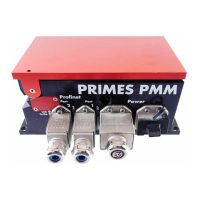

 To Next Page