2
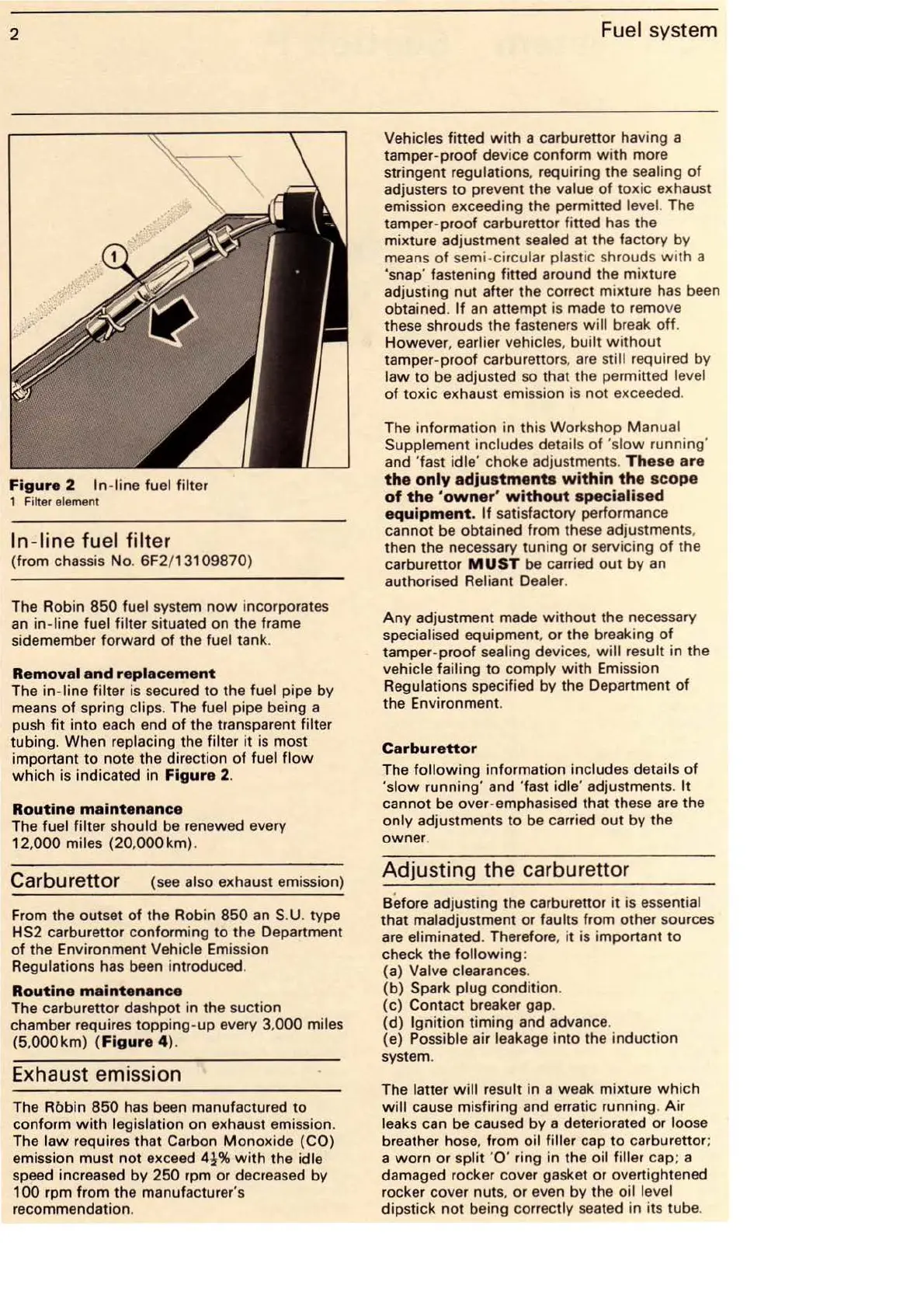
Figure
2
In-line
fuel filter
1 Filter element
In
-l
ine fuel fil
ter
(from chassis
No
. 6F2/
131
09870)
The Robin
850
fuel system
now
incorporates
an
in-line
fuel filter situated on the frame
sidemember forward
of
the fuel tank.
Remov
al a
nd
re
pl
a
cement
The in-line filter is secured
to
the fuel pipe
by
means
of
spring clips. The fuel pipe being a
push
fit
into each end
of
the transparent filter
tubing. When replacing the filter it
is
most
important
to
note the direction
of
fuel
flow
whic
h
is
indicated in Fi
gure
2.
Routine
maintenance
T
he
fuel filter should be renewed every
12,
000
miles (20,000km).
Ca
rbure
tt
or
(see also exhaust emission)
From the outset
of
the Robin 850
an
S.U. type
HS2 carburettor conforming
to
the Department
of
the Environment Vehicle Emission
Regulations has been introduced.
Routine
maintenance
T
he
carburettor dashpot in the suction
chamber requir
es
topping-up every 3,
000
miles
(5,000km)
(
Figure
4).
Exhaust emission
The Rbbin
850
has been manufactured
to
conform
with
legislation on exhaust emission.
T
he
l
aw
requir
es
that
Ca
rbon Monoxide (CO)
emission must
not
exceed 4
!%
with
the idle
speed increased
by
250 rpm or decreased by
100 rpm from the manufacturer's
recommendation.
Fu
el system
Vehicles fitted w i
th
a carburettor having a
tamper-proof device conform
with
more
stringent
regulations, requiring the sealing
of
adjusters
to
prevent the value
of
toxic exhaust
emission exceeding the permitted
level. The
tamper-proof carburettor fitted has the
m
ixt
ure adjustment sealed at the factory by
means
of
semi -circular plast
ic
sh
rouds wtth a
'snap' fastening fitted around the mixture
adjusting nut after the co
rre
ct
mixture
ha
s been
obtained.
If
an
attempt
is
made
to
remove
these shrouds the fasteners
will break
off
.
However,
earlier vehicles,
built
without
tamper-
proof
carburettors,
are
still required by
law
to
be adjusted
so
that the permitted level
of
toxic
exhaust emission
is
not
exceeded.
The information in this Workshop
Manual
Supplement includes details
of
'slow running'
and 'fast
idle' choke adjustments.
These
are
th
e
only
a
dju
s
tm
e
nt
s
wi
th
in the
scope
of
the
'owne
r'
w i
thou
t
specialised
equipment
.
If
satisfactory performance
cannot be obtained from these adjustments,
then the necessary tuning or servicing
of
the
carburettor
MUST
be
ca
rried
out
by
an
authorised
Reliant Dealer.
Any adjustment made
without
the necessary
specialised equipment, or the breaking
of
tamper-pr
oof
sealing devices,
will
result in the
vehicle failing
to
comply
with
Emission
Regulations specified
by
the Department
of
the Environment.
Carbu
r
etto
r
T
he
foll
owing
information includes details
of
'slow
running' and 'fast idle' adjustments. It
cannot be over-emphasised that these are the
only adjustments
to
be carried
out
by the
owner.
Adju
sting the carburettor
Before adjusting the carburettor
it
is essential
that maladjustment or faults from other sources
are
eliminated. Therefore,
it
is
important
to
check the
following
:
(a) Valve clearances.
(b) Spark
plug condition.
(c)
Contact breaker gap.
(d)
Ignition timing and advance.
(e)
Possible air leakage into the induction
system.
The
latter
will
resu
lt in a weak mixture
which
wi
ll cause misfiring and erratic running.
Air
leaks can
be
caused
by
a deteriorated or loose
breather hose, from oil filler cap
to
carburettor;
a worn or
spl
it
·o·
ring in the oil filler cap; a
damaged rocker cover gasket or overtightened
rocker cover nuts,
or
even by the oil level
dipstick not being correctly seated in its tube.



 To Next Page