Cooling system Section E
4 Readjust fan belt tension (see
followi
ng
text).
5 Refit radiator. connect hoses.
refill the
cooling system and check for leaks.
Fan
belt
A single
'V'
type belt is used
to
drive the
alternator and water pump from the crankshaft
pulley.
Correct fan belt tension is important. otherwise
the
belt
itself may be damaged
or
undue strain
placed on the alternator and water
pulley.
If
the
belt is left
slack, poor charging
of
the battery
could result.
There is provision
for
fan belt adjustme
nt
by
pivotting the alternator on its mountings.
It
is
important this adjustment is released
when
a
fan belt is to be fitted, otherwise any attempt
to
strain a
new
belt over the sides
of
the pulleys
can easily ca
us
e damage to the belt.
To
adjust
fan
belt
tension
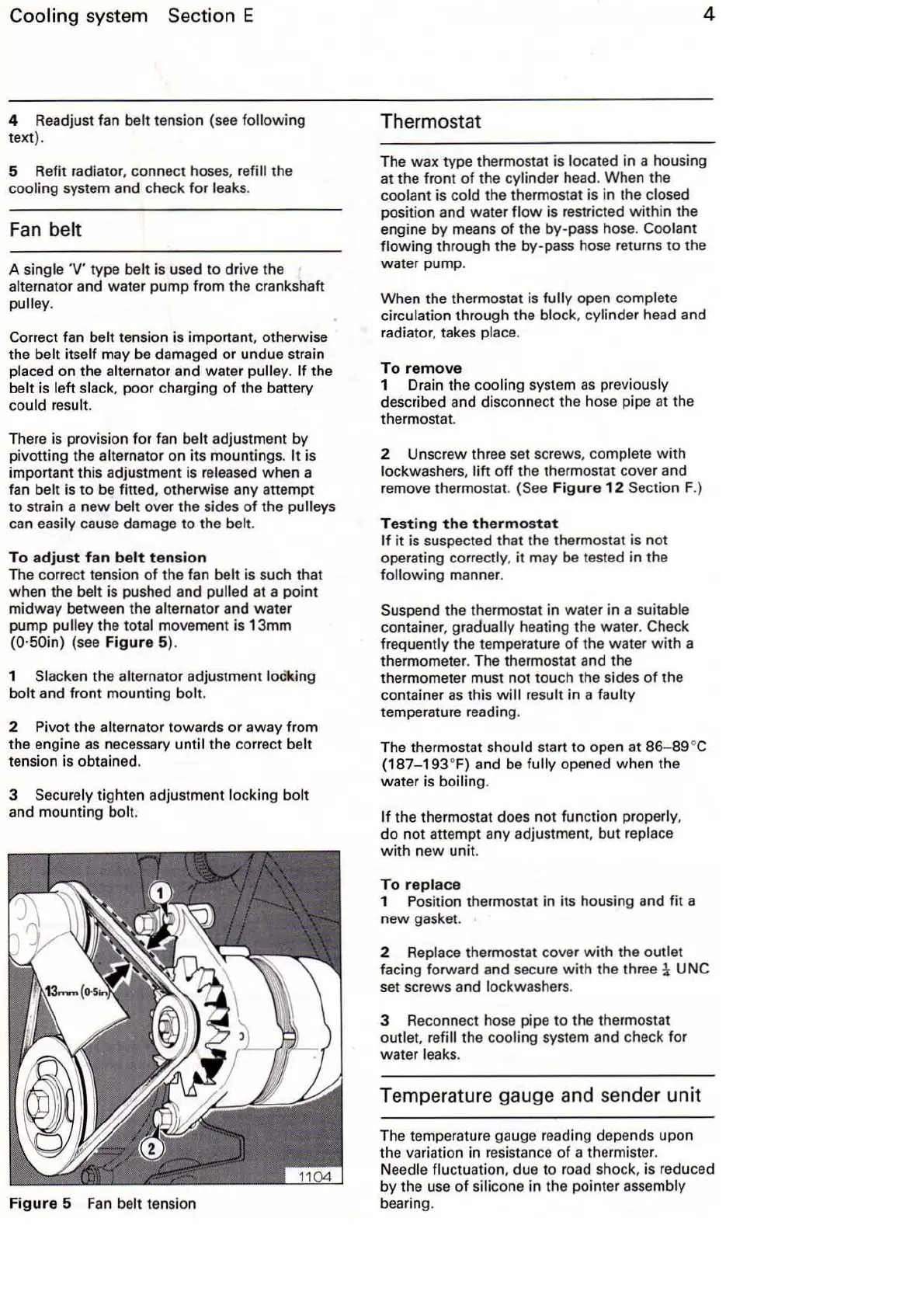
The correct tension
of
the fan
belt
is such that
when
the belt is pushed and pulled
at
a point
midway between the alternator and water
pump
pulley the total movement is
13m
m
(0·50in) (see
Figure
5).
1
Slacken the alternator adjustment locki
ng
bolt
and front mounting bolt.
2 Pivot the alternator towards
or
away from
the engine
as
necessary until the correct belt
tension is obtained.
3 Securely tighten adjustment locking
bolt
and mounting bolt.
Figure
5
Fan
belt tension
4
Thermostat
The
wax
type thermostat is located
in
a housing
at
the front
of
the cylinder head. When the
coolant is cold the thermostat is in the closed
position and water
flow
is restricted
within
the
engine by means
of
the by-pass hose. Coolant
flowing
through the by-pass hose returns to the
water pump.
When the thermostat is
fully
open complete
circulation through the block. cylinder head and
radiator. takes place.
To
remove
1 Drain the cooling system
as
previously
described and disconnect the hose pipe at the
thermostat.
2 Unscrew three set screws. complete
with
lockwashers,
lift
off
the thermostat cover and
re
move thermostat. (See
Figure
12
Section F.)
Testing
the
thermostat
If
it
is suspected that the thermostat is not
operating correctly,
it
may be tested in the
following
manner.
Suspend the thermostat in water in a suitable
container.
gradually heating the water. Check
frequently the temperature
of
the water
with
a
thermometer. The thermostat and the
thermometer must
not
touch the sides
of
the
container
as
this w ill result in a faulty
temperature reading.
The thermostat should start to open at
86-89
°C
(187-193
°
F)
and be
fully
opened when the
water is boiling.
If
the thermostat does
not
function properly.
do
not
attempt any adjustment,
but
replace
with
new
unit
.
To
replace
1 Position thermostat in its housing and
fit
a
new
gasket.
2 Replace thermostat cover
with
the outlet
facing forward and secure
with
the three i
UNC
set screws and lockwashers.
3 Reconnect hose pipe
to
the thermostat
outlet. refill the cooling system and check
for
water leaks.
Temperature gauge and sender
unit
The temperature gauge reading depends upon
the variation in resistance
of
a thermister.
Needle fluctuation, due to road shock. is reduced
by the
use
of
silicone in the pointer assembly
bearing.



 To Next Page