CAUTION: During or after any type of alarm activation (manual or automatic), before
approaching or entering the premises, first be certain that there is no danger present. You
may need to contact responding agencies (police, fire, etc.) in order to confirm whether it is
safe to return to the premises.
➢ To disarm with an alarm:
1. If outside the premises, open a designated "entry" door; the keypad beeps, indicating
that the entry delay time period has started.
2. Observe the following alarm activation indicators:
• The siren sounds
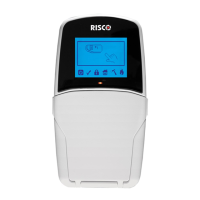
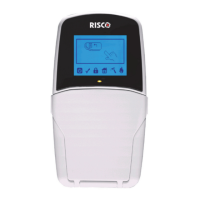
• On keypads with displays, the full-arm icon flashes and the activated zone
displays (for multiple activations, the first activation displays).
• On Slim keypads, the red LED flashes rapidly
• A voice announcement may broadcast: "Alarm occurred in the system"
3. Enter your code (or place Proximity tag near the keypad's Proximity sensor).
4. Press the Disarm button.
5. For keypads with displays, scroll to view all zones with alarm activations.
6. If installer-intervention is required to reset the system after an alarm, see Resetting the
System with Installer/Technician Intervention, page 61.
Returning the System to Normal Operation after Alarm
Activation
After an alarm activation, returning the system to normal operation requires one of the
following:
• A system disarming performed by the Grand Master or system user with
appropriate user authority level. See Disarming with Alarm Activation (Silencing an
Alarm), page 59.
• A system disarming by Grand Master or system user, followed by the installer/
technician resetting the system (required after each alarm activation). See Resetting
the System with Installer/Technician Intervention, page 61.
• A procedure for the Grand Master to disable and reset Smoke/Heat detectors after
a smoke/heat alarm activation. See Disabling Smoke/Heat Detectors after Alarm
Activation, page 62.
• A procedure for the Grand Master or installer/technician to restore the system
upon power-supply overload for the 3 amp power supply module. See Restoring
the System upon Power Supply Overload, page 63.


 To Next Page