64 Programming SATEL
109. ZONES LOGICAL AND – active, when all zones selected as the control ones are violated.
110. ALARM – NOT VERIFIED – signals unverified alarms.
111. ALARM – VERIFIED – signals verified alarms.
112. VERIFIED – NO ALARM – informs that the alarm has not been verified (during the alarm
verification no alarm was triggered by any other zone included in the verification).
113. VERIFICATION DISABLED STATUS – signals disabling alarm verification.
114. ZONE TEST STATUS – indicates the zone testing by means of user functions.
115. ARMING TYPE STATUS – active when selected partitions are armed in the selected mode.
116. INTERNAL SIREN – signals the same alarms and violations as the 1. BURGLARY or 9. DAY
ALARM output type (logic product of the 1. BURGLARY and 9. DAY ALARM outputs).
117. TAMPERING STATUS – informs about tamper of selected zones, keypads and expanders.
118. KEYFOB BATTERY LOW – informs about low battery in keyfobs belonging to selected
users. Refers to the 433 MHz keyfobs (supported by the INT-RX or INT-RX-S modules) or
the APT-200 (supported by the ABAX 2 / ABAX system) / APT-100 keyfobs (supported by
the ABAX system).
119. WIRELESS SYSTEM JAMMING – indicates the jamming of device supporting the ABAX 2
(ACU-220 or ACU-280 controller) / ABAX wireless system (ACU-120, ACU-270, ACU-100
or ACU-250 controller).
120. THERMOSTAT – the output activates when temperature drops below a preset value. The
control panel can receive the temperature data from wireless temperature detectors or
ABAX 2 wireless devices provided with a temperature sensor. For more information, refer
to section “120. Thermostat output parameters” p. 66.
121. MASKING – signals for a programmed time masking the detectors connected to the 3EOL
zones.
122. MASKING STATUS – indicates the masking the detectors connected to the 3EOL zones.
5.3 Options
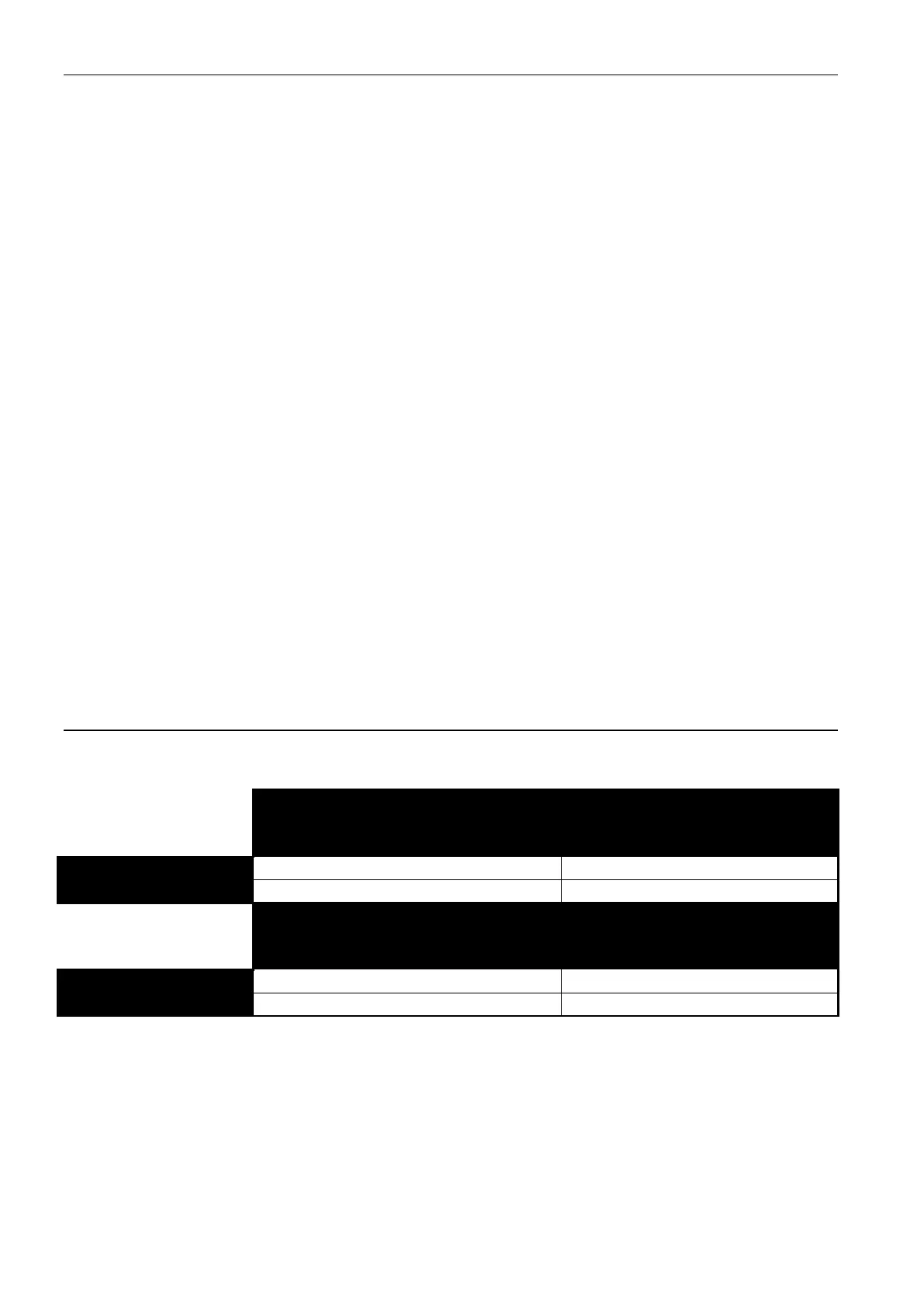
Pol.+ – defines the output operating mode (see Table 5).
option enabled
(normal polarity)
option disabled
(reversed polarity)
option enabled
(normal polarity)
option disabled
(reversed polarity)
Table 5. Functioning of outputs, depending on the POL.+ option.
Pulsating – the option refers to timed outputs. If it is enabled, the output operates in
a pulsating mode. If it is disabled, the output operates continuously.
Latch – the option refers to alarm outputs. If it is enabled, the output will be active until the
alarm is cleared by the user.
Active during violation – the option applies to the 24. MONO SWITCH output. If enabled, the
output is always active when a control zone is violated, and the countdown of output cut-
off time will only be running after the violation ends.



 To Next Page