Questions? Call or Text +1-801-658-0015 • 15
signed to remove surface inconsistencies and contaminants which helps to displace oils, break through oxide
layers, and seat the welding electrodes. See Figure 14.2 to view this type of weld graphically.
The Pulse 1 energy setting should be chosen such that the parts adhere weakly. To determine Pulse 1, turn o
Pulse 2 and do a series of test welds starting at a low pulse energy setting. Increase the pulse energy about 3%
every test until the parts barely stick together. Pulse 1 energy is typically below 10% of the total available weld
energy of the welder. Pulse 2 energy is typically between 50% and 70%.
Pre-Weld Delay
The Pre-Weld Delay controls the amount of time between when the weld is trigger/initiated and when the weld
energy is released.
Delay Between Pulse
This delay controls the amount of time between the end of Pulse 1 and the beginning of Pulse 2. This will be
represented on the waveform display. This option is only available when both pulses are enabled.
Welder Charge State
The welder charge state is a small indicator on the bottom of this screen. The indicator will display one of three
colors:
• Green indicates that the welder is charged and ready to weld.
• Black indicates that the welder is not ready to weld, or the Weld On/O button is o.
• Red indicates that the E-Stop is engaged.
Additional Weld Energy Notes
For new applications, a test weld should be performed, and the resulting weld should be evaluated for strength.
To do so, perform the weld, and then try to pull the pieces apart to determine weld strength.
For example, a nickel strip welded to nickel plated steel, as typically seen in battery pack manufacturing, should
pull apart leaving holes in the thin nickel metal and leaving the weld nuggets on the battery terminal. If the nickel
‘pops’ o without tearing, more energy should be used. Thicker materials should be pulled with a specic pull
force requirement in mind.
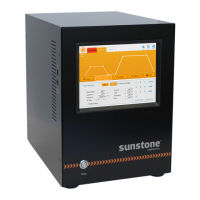
Each Sunstone welder is fully adjustable between its minimum and maximum energy. Sunstone capacitive dual
pulse welders have weld repetition rates of up to 650 welds/min. See page 88 for additional details on weld
repetition rates.


 To Next Page