appendix a
224
SYNRAD FH Series Flyer Operator’s Manual Version 3.4
Cooling
The Cooling section includes subsections:
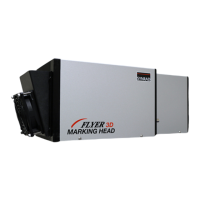
Cooling FH Flyer
Heat load factors
Calculating heat load
Mounting an auxiliary cooling fan
Cooling FH Flyer
If you are currently cooling your FH Series Index or Tracker marking head, you should continue to cool FH
Flyer in the same manner. However, please note that Flyer’s heat load is concentrated on the front end of
the head—at the nned heat sink end, not the L-bracket (input) end.
You must add external cooling if any of the following conditions exist: (1) the heat sink has less than 1.0"
(25.4 mm) of free air space between the head and any enclosure or surface, (2) the head is oriented such
that the heat sink is pointing downward or in any other non-standard orientation, or (3) Flyer’s calculated
maximum internal temperature at the optical scanners is higher than 50 °C.
You can monitor Flyer head temperature in real-time using our WinMark Pro laser marking software. To do
this in WinMark Pro, click the Help menu and then click About Synrad WinMark… . The About Synrad
WinMark… dialog box displays internal air temperature near power amplier and CPU components along
with a color-coded Status indicator. If the Status indicator, normally green, turns yellow (indicating power
amp air temperatures at or above 65 °C), then you should consider adding an external cooling fan. FH
Flyer will stop marking if the CPU’s ambient air temperature reaches 65 °C (when the Status indicator
turns red). If this happens, marking will halt and you must cool the head. Marking is not enabled again
until ambient CPU air temperature drops below 60 °C.
Note: Real-time air temperature measurements at power amplier and CPU locations inside Flyer have
been correlated with optical scanner air temperatures after extensive testing. A measured air
temperature of 65 °C at the CPU indicates that air temperatures surrounding the optical scanners
are approaching their maximum temperature limit of 50 °C.
Heat load factors
Several factors in
uence the internal temperature of the marking head including external ambient air
temperature, airow, marking speed, o-vector speed, mark object type and size, mark duty cycle, and head
mounting orientation. Each item is described in detail below. An understanding of the factors that aect
heat load and head performance will assist you in optimizing your integrated FH Flyer marking system for
best performance and long service life.
External ambient air temperature
Ambient air temperature refers to the air temperature in the immediate vicinity of the Flyer head. If the
marking head is installed inside an industrial-type processing machine, then the machine’s shielding and
covers, along with drive motors and other heat-generating components, may raise the ambient tempera-
ture inside the machine to a point well above the ambient air temperature of the room where the
machine is placed. Flyer’s environmental specifications (see Table 5-18) for operating temperature is
within the range of 0 °C to 40 °C in a non-condensing environment—where the combination of air
temperature and humidity are above the dew point (the point at which condensation forms).


 To Next Page