Battery mode
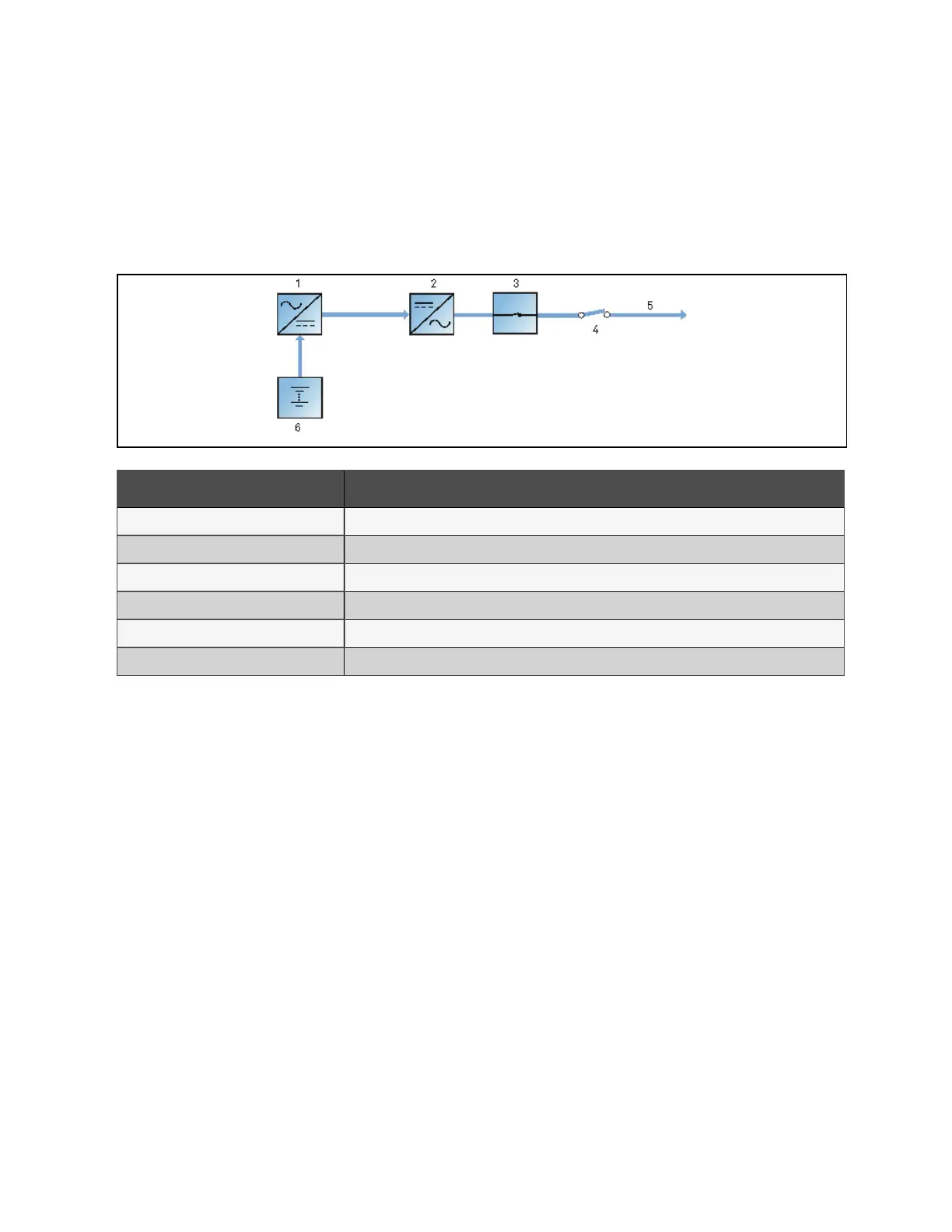
As shown in Figure 2.4 below, the operation mode in which the battery provides backup power supply to the loads through the
rectifier and inverter is called battery mode. Upon mains failure, the system will automatically transfer to the battery mode
with no load power interruption. When the mains is recovered, the system will automatically transfer back to the normal mode
without any manual intervention, and the power to the load will not be interrupted.
Figure 2.4 Schem atic diagram of battery mode
N o. Descriptio n
1 Rectifier
2 Inverter
3 Automatic inverter switch
4 Output switch
5 UPS output
6 Battery
N O T E: Battery cold start function is available for sw itching the U P S on from Battery (charged ) m ode
directly during m ains failure. Therefore, the battery pow er supply can be used independ ently to
im p rove the availability of the UPS.
Automatic restart mode
The UPS has automatic restart function. When the inverter shuts down because of the mains failure and the battery
discharges to EOD voltage, if the mains is recovered, the UPS will restart automatically after a certain time of delay. This
function and the automatic restart type can be set by the service engineer authorized by Vertiv.
During the process of automatic restart time of delay, the UPS will charge the battery to protect against the power-off risk of
the load device caused by mains power failure.
If the automatic restart function has not been set, the user can manually start the UPS through RESET FAULT function.
Bypass mode
As shown in Figure 2.5 on the next page, in normal mode, in case of an inverter failure, an inverter overload, or an inverter
manual shutdown the static switch will transfer the load from the inverter side to bypass side, with no interruption in power to
the load. At this time, if the inverter and bypass are not synchronized, power supply to the load has transitory interruption, with
time of less than 20 ms.
2 Overview
10
Vertiv™ Liebert® APM Plus User Manual



 To Next Page