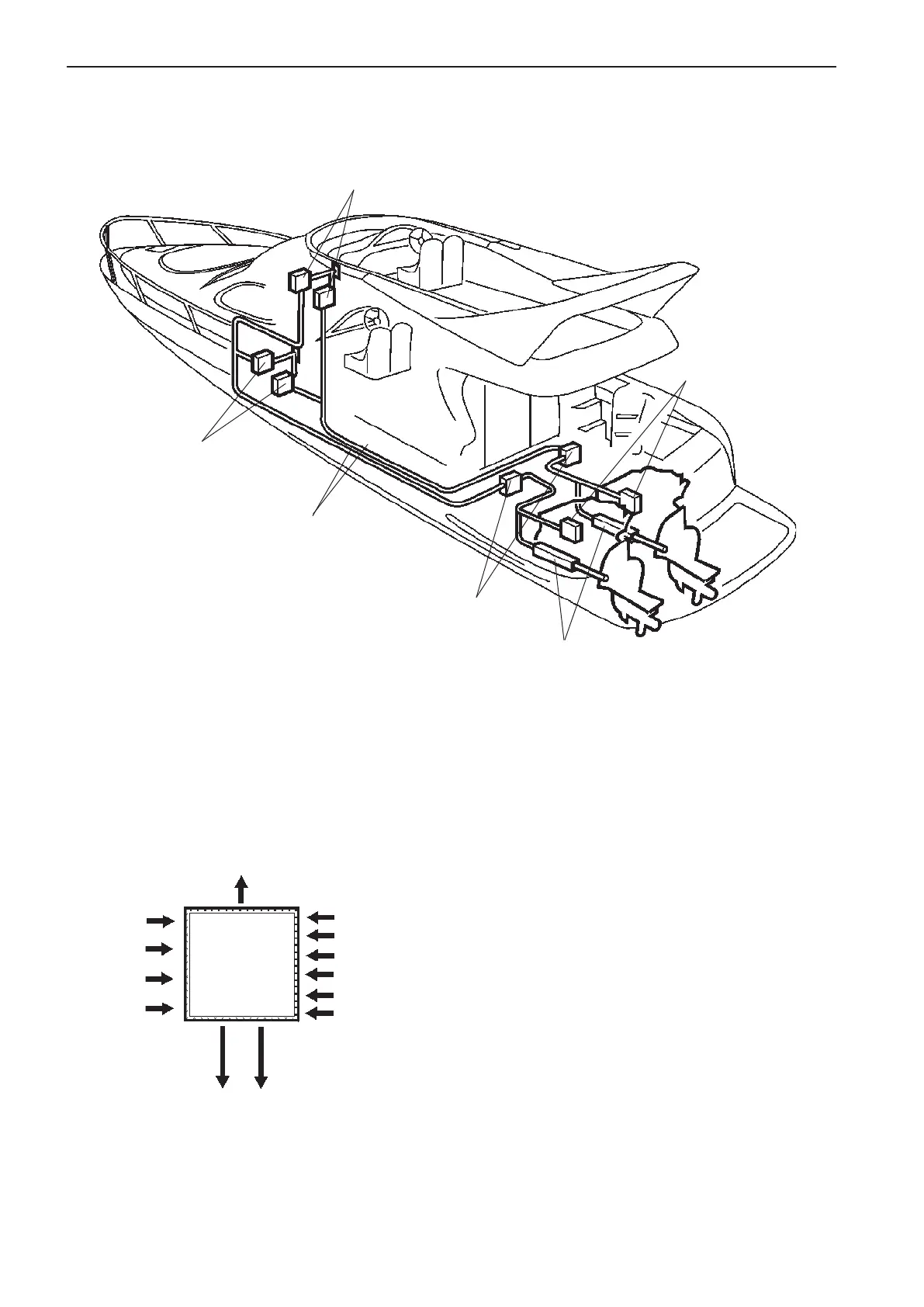
Engine monitoring system
The engines are equipped with common rail system
and electronically controlled injectors (D4, D6) or unit
injectors (D9, D12, D16) with an electronic control
Engine monitoring and the EVC system
unit.
The injectors contain an electro-magnetic valve which
sets the amount of fuel injected and the correct tim-
ing. The monitoring system measures the charge air
pressure and temperature, and calculates the avail-
able air mass. This determines the maximum amount
of fuel that can be injected (smoke limiter function).
The system also limits the maximum torque available
at the engine speed registered to protect the engine
and transmission from overload.
To protect the engine at too high coolant or charge air
temperatures and boost pressure as well as oil pres-
sure, the monitoring system reduces the amount of
fuel (reduced engine output) until the current values
are normalized.
The engine monitoring system also has a diagnostic
system, which helps users and service technicians to
determine the cause of any malfunctions in the sys-
tem quickly by using the diagnostic tool.
Any fault is shown on the EVC system tachometer
display / EVC system display and the VODIA diag-
nostic scan tool. The diagnostic tool has menus in
several languages.
Diagnostics
Engine speed
Throttle
Oil pressure
Oil temp.
Cooling temp.
Charge air press.
Charge air temp.
Fuel temp.
Water in fuel
Camshaft pos.
Ignition
timing
Fuel
quantity
Engine
Control
Unit
HCU
(Helm station
Control Unit)
PCU
(Powertrain
Control Unit)
ECU
(Engine
Control Unit)
HCU
(Helm station
Control Unit)
CAN bus
Actuator
(gear shifting
DPH/DPR)
10



 To Next Page