REMOTE CONTROL (GPIB & RS-232) 5–6
5.2.5 Data Output
5.2.5.1 Output Syntax
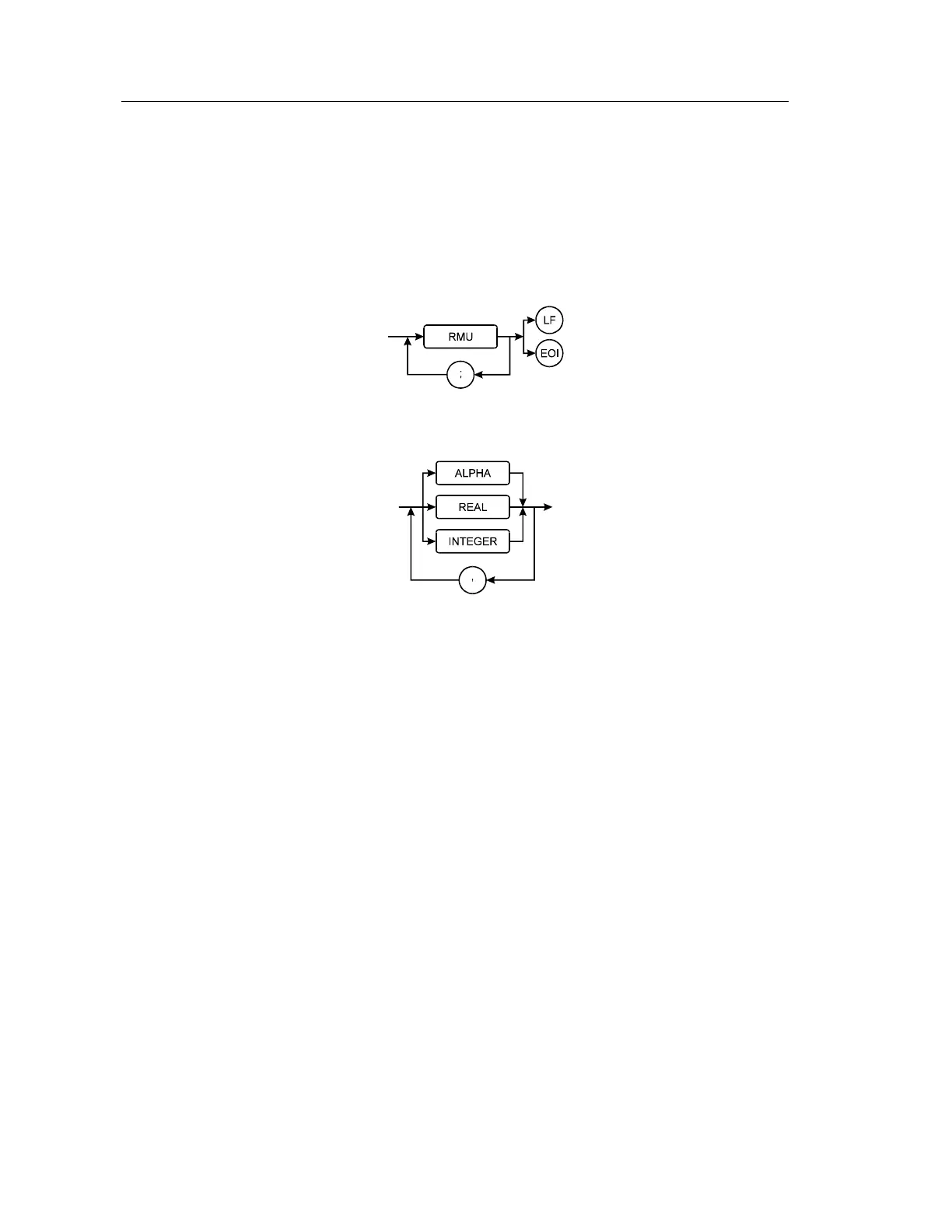
For each query which generates an output response, a Response Message Unit (RMU), will be
generated. This consists of a string of numbers or alphanumeric characters; if more than one
RMU is generated they will be delimited with a semicolon. The terminator, line-feed and EOI
asserted indicates the end of data output. All characters will be upper case.
Figure 5-3 GPIB Data Output
Figure 5-4 GPIB RMU Structure
5.2.5.2 Multiple Items
Some commands will generate an RMU containing more than one item of data (e.g. TRIG will
generate a first and second result). In this case, each item of response data will be separated by
a comma. Note that the maximum number of characters that can be output is 256, any data
beyond this will be lost.
If the command string contained multiple queries then the response will contain multiple
RMUs, each of which will be separated by a semicolon.
5.2.5.3 Numeric Format
The format of numeric results will correspond to that used for the instrument display, with the
engineering multiplier (if any) replaced by an equivalent 10’s exponent. If the FAST-GPIB
mode is being used then numbers will be output in a raw engineering format.
5.2.6 Status Reporting
5.2.6.1 Status byte
The status byte is used to summarize information from the other status groups. It is shown in
Figure 5-5, which conforms to IEEE 488.2 and SCPI. The status byte can be read by the query
command *STB? or by performing a serial poll on the instrument (these two are identical
although the point at which the RQS bit can be cleared is slightly different).


 To Next Page