Installation and Commissioning Guide
Split Tri-Capacity
77
Installation and Commissioning Guide 500-700 Tri-Capacity Split Ducted
Doc. No.0525-098 Ver. 2 210330
28.01. Charging Method 1: Subcooling and Superheat
Parameters:
LLT = Liquid Line Temperature SLT = Suction Line Temperature
SCT = Saturated Condensing Temperature SST = Saturated Suction Temperature
Cooling Operation: Heating Operation:
Subcooling should be between 4K and 8K. Subcooling should be between 8K and 14K.
Superheat should be between 2K and 8K. Superheat should be between 2K and 8K.
28.01.01. Cooling and Heating Operation:
Pipe lengths will affect the superheat and subcooling of pre-charged units. Pipe runs shorter than the pre-
charged length will result in higher subcooling and a lower superheat. Pipe runs longer than the pre-charged
length will result in lower subcooling and higher superheat. Adjust the refrigerant charge to obtain the correct
super heat and subcooling for optimal performance as follows:
1. Ensure that air filters are fitted to indoor unit and total system airflows are balanced. (Air filters are not
supplied with the unit, it is the responsibility of the installing contractor to provide and fit adequate
return air and outside air filters).
2. Connect service gauges to the shut off valves. Two sets of R-410A service gauges are required, each one
connected to circuit 1 and 2, in order to conduct simultaneous refrigerant charge adjustments.
3. Mount the temperature sensing devices (one for each circuit) on the liquid line as close as possible to
the liquid and suction line service valve.
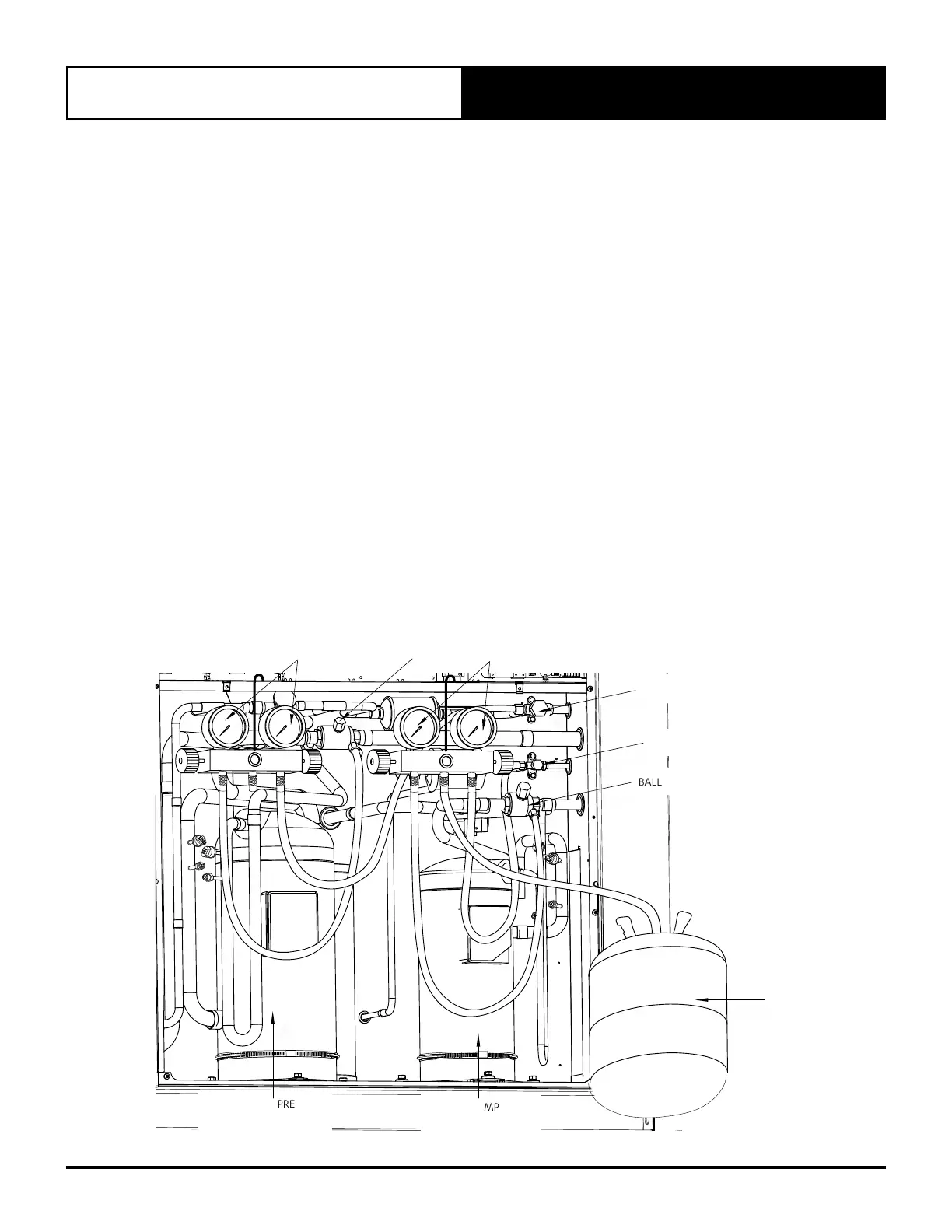
See Diagram Below
BALL VALVE CIRCUIT 1
POST VALVE CIRCUIT 1
POST VALVE CIRCUIT 2
R410A
REFRIGERANT
CONTAINER
BALL VALVE CIRCUIT 2
SERVICE GAUGES 2
SERVICE GAUGES 1
LARGE COMPRESSOR
CIRCUIT 2
SMALL COMPRESSOR
CIRCUIT 1


 To Next Page