SW Version 2.04 30-January-2009 Page 93 of 128
The cryptographic method uses the open standard MD5 (Message Digest type 5)
encryption standard. MD5 is a one-way irreversible cipher. Two devices exchange only
the MD5-encrypted versions of the password. Both devices know the same password.
Each router is able to verify that the encrypted password that it receives is correct by
using the same algorithm to encrypt the password that it already knows. To make
sure that nobody can just intercept and use the encrypted version of the password
directly, a time value that the receiving router also knows is added to the password
before encrypting. Anybody else listening on the network is only able to see the
encrypted version of the password, but they cannot deduce the original password.
If you use authentication in an OSPF area, you must configure all of the routers in the
area to support authentication. Every interface on a router doesn't have to be
configured with authentication. But if you require authentication in any part of an
area, you must include authentication support throughout the area.
4.7.5.8 Defining the Source IP Address
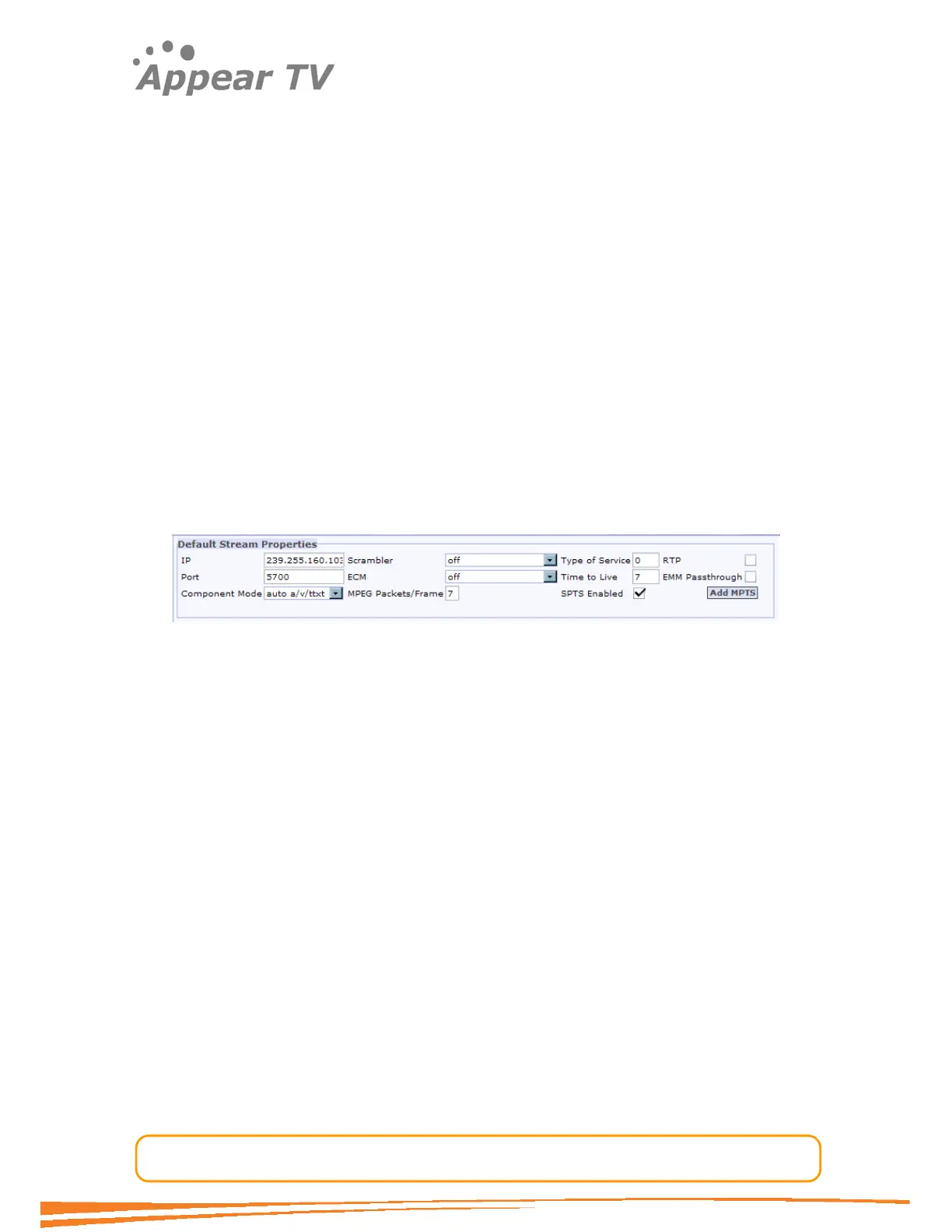
The source address must be in the same subnet as the Source net defined above. The
actual address is defined as part of the configuration of the IP output multicast (SPTS
or MPTS). To open the configuration page, click OutputsÆIP
In the configuration dialog it is possible to define the last digit in the network address,
which together with the source network gives the complete source IP address.
Then click Add MPTS Æ Port Settings and tick the Output Redundancy check box
to enable output redundancy



 To Next Page