A 7
1.2 Register status in the registration period data block
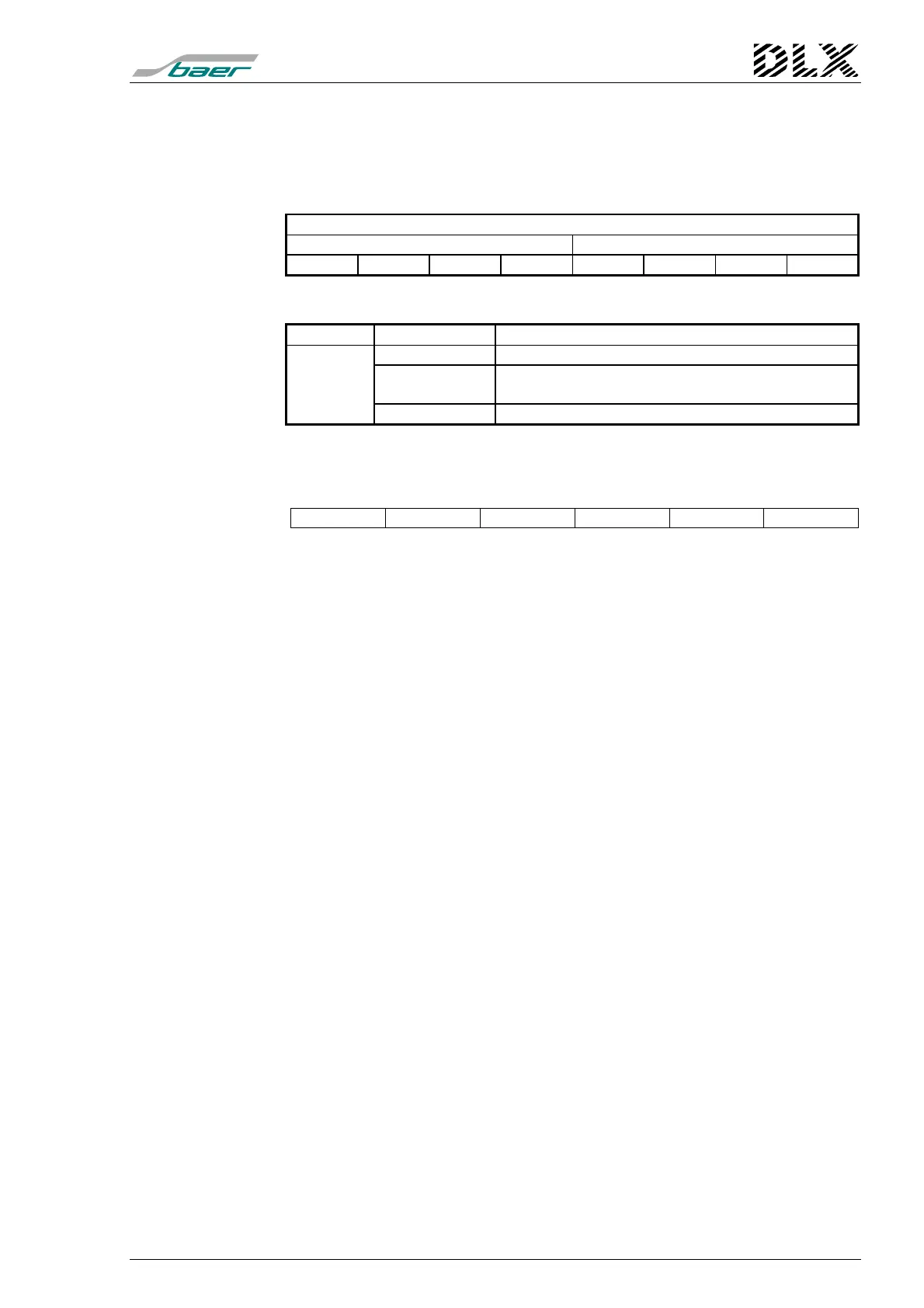
In each registration period the DLX stores a register status of 1 byte (2
characters) for each entry in the periodic buffer. This status is stored in the
same format as the device status (hexadecimal notation):
Byte 1
Character 1 Character 2
Bit 7 Bit 6 0 Bit 4 0 0 0 0
Meaning of individual bits:
Byte-No. Bit-No. Description
Byte 1 Bit 7 Parameter change for this register by the user
Bit 6 Power failure, no data telegrams or errors from
analogue input for at least 60 seconds
Bit 4 Overflow of this register
1.3 Retrieval of events (spontaneous event buffer : 051-xx)
The messages have the following format:
PL ETYPE ETIME EADR OSTATE NSTATE
PL: Packet length (24 or 43 bytes)
ETYPE: Type of event. The following event types are possible:
A1 – Alarm has occurred
A3 – Power outage
C1 – Parameter or value changed on site
C2 – Parameter or value changed via remote connection
D1 – Time was set on site
D2 – Time was set via remote connection
D3 – Change from wintertime to summertime
D4 – Change from summertime to wintertime
ETIME: Timestamp of the event: YY MM DD hh mm (Year Month Day Hour Minute)
EADR: Address of the information affected by the event (not applicable for mes-
sages such as “Time was set” or “Power failure”): 051xx, xx: number of the
entry in the spontaneous event buffer modulo 100.
OSTATE: Old state of the information affected by the event (not applicable for mes-
sages such as “Time was set” or “Power failure”), see the table in section
13 „Fault displays“.
NSTATE: New state of the information affected by the event, see the table in section
13 “Fault displays“.


 To Next Page