A 42
3 Modbus RTU Protocol
From firmware version 1.05.00 and up is it possible to use the protocol
Modbus RTU (Remote Terminal Unit) for data retrieval (alternatively to
SCTM / IEC 60870-5-102).
3.1 Telegram processing
The following rules define the protocol for information transfer between a
Modbus MASTER and the DLX:
• The DLX supports only the “Modbus RTU mode of transmission”: Read
Holding Registers.
• Transmission settings: 8, N, 1 (1 start bit, 8 data bits, no parity, 1 stop bit).
• All communications on the network or bus conform to a MASTER/SLAVE
scheme. In this scheme, information and data is transferred between a
Modbus MASTER device (e.g. SIGLON AMR Software) and up to 32
SLAVE devices (DLX).
• The MASTER initiates and controls all information transfer on the commu-
nications loop.
• A SLAVE device (DLX) never initiates a communications sequence.
• All communications activity on the loop occurs in the form of “PACKETS”. A
packet is a serial string of 8-bit bytes. The maximum number of bytes con-
tained within one packet is 255.
• All packets transmitted by a MASTER are REQUESTS. All packets trans-
mitted by a DLX are RESPONSES.
• At most one DLX can respond to a single request from a MASTER.
3.2 Telegram structure
Every Modbus packet consists of four fields (Request := eight bytes):
• Slave Address Field: one byte between 1 and F7
Hex
; (:= 1 to 247
Dec
)
• Function Field: one byte (:= 3 / fix, Read Holding Registers)
→ Modbus address := device address – 40001
• Data Field:
Request: four bytes (start register: 2 bytes, # of reg.: 2 bytes)
Response: x bytes (counter: 1 byte, n registers: 2*n bytes)
• Error Check Field (Checksum): two bytes, a 16-bit Cyclic Redundancy
Check (CRC-16)
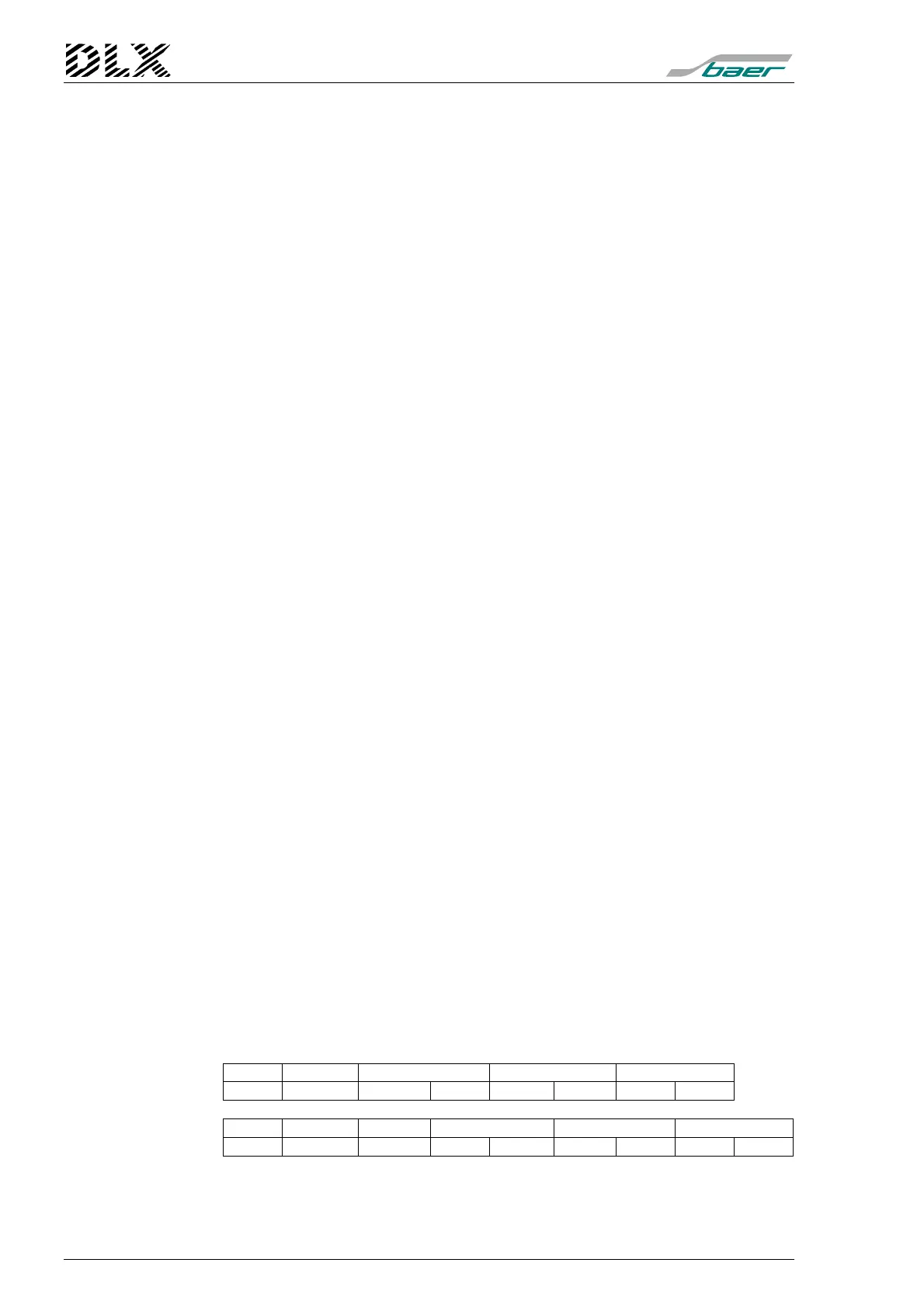
Example: Address: 1 / Start register: 102
Dec
(00 66
Hex
) / # of registers: 2 (32-bit)
Request: Addr. Function
Start register # of Register CRC
01 03 00 66 00 02 65 CB
Response: Addr. Function
Counter
Register 1 Register 2 CRC
01 03 04 00 00 00 12 49 3E
Value = 18 (00 00 00 12
Hex
)


 To Next Page