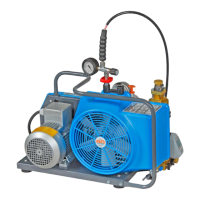
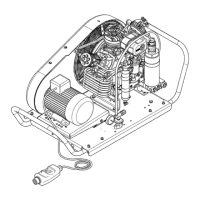
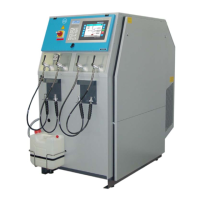
Instruction Manual w VERTICUS 5 Compressor Units
C-5
Before carrying out any exceptional work or repairwork,
operating personnel should be informed. Call the super
visor.
For all work concerning operation, change in produc
tion, conversion or regulating of the machine / unit and
its safety measures such as inspection, maintenance and
repairwork, observe the switching on and off processes
in the instruction manual and the notices for mainten
ance work.
Clear and make the maintenance area safe as far as ne
cessary.
If the machine / unit is completely switched off for main
tenance and repairwork, ensure that it is protected from
unexpected start-up. Turn off main control device and
remove the key and / or display a warning sign on the
main switch.
When replacing individual parts and larger assembly
groups, they must be carefully fastened to the lifting
device so that there is no risk of danger. Use only suit
able and technically perfect lifting devices and equip
ment with sufficient lifting power and strength. Do not
linger or work under suspended loads.
Only entrust an experienced person with the fixing of
loads and guiding of crane drivers. The person guiding
must remain within sight or in contact with the oper
ator.
For assembly work above body height, use appropriate
safety approved equipment, e.g. ladders and platforms.
Do not climb on machine parts. For maintenance work
at high levels, wear a safety harness.
Clean oil, fuel or care products from the machine, in par
ticular the connections and screw joints, before carrying
out maintenance / repairwork. Do not use aggressive
cleaning fluid. Use a fibre-free cleaning cloth.
Before cleaning the machine with water or jet of steam
(high pressure cleaner) or detergent, cover / seal all
openings which for safety and/or operating reasons no
water / steam / detergent may penetrate. Electric motor
and switch cabinets are particularly at risk.
When cleaning the operating room, ensure that the
temperature sensors of the fire alarm and sprinkler sys
tem do not come into contact with hot cleaning fluid,
in order to avoid triggering the sprinkler system.
Completely remove all covers / seals after cleaning.
After cleaning, check all pressure lines for leaks, loose
connections, wear and damage. Immediately eliminate
any faults.
Always retighten any screw connections loosened for
maintenance or repairwork.
If it is necessary to remove safety devices for mainten
ance and repairwork, these must be replaced and
checked immediately after completion of the mainten
ance or repairwork.
Ensure safe and environmentally friendly disposal of
consumables and old parts.
1.3.5. Particular areas of danger
Use only original fuses with specified current rating. If
there is a failure in the electric energy supply, shut the
machine / unit down immediately.
Work on electric units or operating equipment may only
be carried out by a qualified electrician or by a person
under the instruction and supervision of a qualified elec
trician according to electric technical regulations.
Machines and unit parts which must undergo inspec
tion, maintenance and repairwork, must be disconnec
ted from the mains supply, if specified. Parts which have
been disconnected must first be checked for voltage,
then earthed and short-circuited and isolated from live
neighbouring parts.
The electrical equipment of a machine / unit must be
regularly checked. Defects, such as loose screw connec
tions or burnt wires, must be rectified immediately.
If work is to be carried out on live parts, work with a
second person who can operate the emergency off
switch or the main switch in the case of an emergency.
Close off the work area with a red and white safety
chain and a warning sign. Only use voltage isolated
tools.
Only carry out welding, burning and grinding work on
the machine / unit when specifically approved. There
can, for example, be a risk of fire or explosion.
Before carrying out welding, burning or grinding work,
clean the machine / unit and surrounding area from dust
and flammable material and ensure there is adequate
ventilation (danger of explosion!).
When working in small rooms, observe any national reg
ulations.
Only personnel with particular knowledge and experi
ence with pneumatics may carry out work on pneumatic
equipment.
Check all pressure lines, hoses and screw connections
regularly for leaks and visible damage. Immediately re
pair any damage. Escaping air or gas under pressure can
cause injury and fire.
Depressurize system and pressure lines before commen
cing repairwork.
Pressurized air lines must be laid and mounted by quali
fied personnel. Connections must not be mixed up. Fit
tings, length and quality of the piping must correspond
to requirements.


 To Next Page