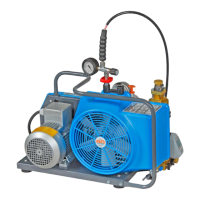
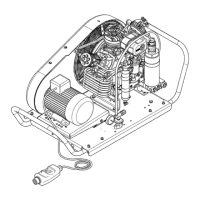
Instruction Manual w VERTICUS 5 Compressor Units
C-6
Soundproofing equipment on the machine / unit must
be in place and functional during operation.
The stipulated hearing protectors must be worn.
With regard to oil, grease and other chemical sub
stances, observe the relevant safety regulations for the
product.
For loading, only use lifting device and equipment with
sufficient lifting power and strength.
Appoint trained guide personnel for lifting operations.
Machines may only be lifted with a lifting device and by
trained personnel according to instructions in the in
struction manual (fixing points for fixing equipment
etc.).
Use only suitable transporters with sufficient carrying
power.
Secure the load properly. Use suitable fixing points.
If necessary, provide machine / unit with transportation
brackets. Display the appropriate notice. Remove trans
portation brackets in the correct manner before taking
into operation.
Parts which need to be dismantled for transport pur
poses must be carefully replaced and secured before
taking into operation.
Even when moving the machine / unit only slightly, the
machine / unit must be disconnected from all external
energy sources. Before putting into use again, recon
nect the machine to the mains according to regulations.
When taking back into operation, proceed according to
the instruction manual.
1.3.6. Notices of danger regarding pressure ves
sels
Never open or loosen pressure vessel lids or pipe con
nection parts under pressure; always depressurise the
vessel or the unit.
Never exceed the permissible operating pressure of the
vessels!
Never heat the vessels or any of their parts above the
stated, maximum operating pressure.
Always exchange damaged pressure vessels com
pletely. Individual parts that are subject to pressure
loads cannot be purchased as spare parts, since the ves
sels are tested as a complete part and the documenta
tion considers them as a whole (see pressure vessel doc
umentation, serial-numbers!).
Always pay attention to the permissible operating mode
of the pressure vessels.
We differentiate:
- vessels for static load
- vessels for dynamic load
Vessels for static load:
These pressure vessels are permanently under virtually
constant operating pressure; the fluctuations of pres
sure are very small.
Vessels for this type of load are not marked in a particu
lar way and may be used as long as the vessel inspec
tions, carried out regularly, do not uncover any safety-
relevant deficiencies.
Vessels for dynamic load:
These pressure vessels may also be used under condi
tions of changing operating pressure. The pressure may
vary between the atmospheric and the maximum ad
missible operating pressure.
The pressure vessel documentation and the appropriate
notes in the operating manual particularly characterise
vessels of this type as being adequate for dynamic loads.
In the technical information for these vessels you will
find specifications concerning their permissible operat
ing period.
Due to the variation of the operating pressure, these
vessels are subject to a so-called dynamic load, which
puts the vessels under great stress. The change between
two different pressures is called a load change or cycle.
In the technical information for these vessels you will
find specifications concerning the permissible number
of cycles depending on the fluctuation of the operating
pressure.
Having reached half the permissible number of cycles,
the vessel has to be submitted to an internal check, in
which the critically stressed areas of the vessels are ex
amined by means of suitable testing methods, in order
to ensure the operating safety.
After having reached the total permissible number of
load cycles, the vessel must be exchanged and
scrapped.
Record the number of load cycles in writing if you do not
have an automatic cycle-counter.
We recommend that aluminium vessels
should be exchanged after 15 years at the
latest.
Please pay attention to and follow these measures, for
your own safety and that of you employees and custom
ers!
In order not to unnecessarily load the pressure vessels
additionally, the non-return valves, that are meant to
avoid a drop in pressure, and also the pressure maintain
ing valves, which should reduce big pressure fluctu
ations as well, should be checked regularly for internal
and external tightness and functionality.
Check the pressure vessels regularly on the inside and
outside for damage from corrosion.


 To Next Page