WARNING
WARNING
WARNING
Instruction Manual w VERTICUS 5 Compressor Units
C-11
2.5. FILLING PROCEDURE
2.5.1. General
Ensure intake air is free from
noxious gas (CO), exhaust fumes
and solvent vapour. When opera
ting the unit in areas with possibly high CO contents,
the CO removal filter cartridge is recommended. Note
that for CO contents of more than 25 ppmV in the in
take air the allowed limits cannot be guaranteed even
with a CO removal filter cartridge, resulting in a life-
threatening CO concentration! Also, due to chemical
reaction of CO with hopcalite, warming up of the car
tridge and danger of fire may result.
Filling hoses must be in satisfac
tory condition and threads undam
aged. Pay particular attention to
damage on the interface from hose fitting to hose. If
the casing is scored, hose must be discarded other
wise water can enter and attack wire gauze causing
it to rust and thus endangering pressure tightness.
The filling valve connection is of the manual type and per
mits connection to air tanks without using tools. An O-ring
is provided for self-sealing by internal overpressure.
Compressed air tank filling valves for a pressure in excess of
200 bar are standardized (DIN 477, sheet 5) and connectors
for 200 and 300 bar are different and cannot be mixed up.
The use of adapters is not allowed! To ensure safe air
tank removal after filling, the valve has an integral venting
bore. Therefore always close tank valve first before closing
filling valve.
During filling procedure bottles will warm up due to recom
pression. After removing, allow to cool down, bottles may
then be reconnected and topped up to the appropriate
maximum filling pressure.
To meet the CO
2
maximum rating
value in breathing air bottles,
please observe the two following
chapters ”Intake air quality” and
”Scavenging the compressor unit”.
2.5.2. Intake air quality
At routine tests, CO
2
values beyond the permissible values
are noted from time to time. Closer investigations often
show that the compressed air is taken from rooms in which
one or more persons are working. At insufficient ventila
tion, the CO
2
value in the surrounding air can increase quite
fast because of the exhaling of CO
2
. CO
2
values from 1,000
to 5,000 ppm
v
in workrooms are not unusual (MAK-value
(max. workroom concentration) is 5,000 ppm
v
). Another
additional increase is caused by cigarette smoking, produ
cing approx. 2g CO
2
( 2,000 ppm
v
) per cigarette. These
pollutions add up to the basic pollution of approx. 400
ppm
v
. The technically caused excessive increase of CO
2
dur
ing the filling process and the CO
2
peak at taking the unit
into operation. Because of the reasons stated above
and for your own security, the filling of breathing air
bottles is not allowed in rooms used as workrooms.
2.5.3. Scavenging the compressor unit
CO
2
is present in the atmosphere with a natural amount of
350 - 400 ppm
V
. The molecular sieve used in the purifiers
for drying the breathing air is, as well as other capabilities,
able to adsorb CO
2
which is accumulated in the cartridge.
After shutdown of the compressor, adsorbed CO
2
may be
desorbed again due to the partial pressure decrease. The
now free CO
2
gets washed out of the cartridge when the
compressor is started again.
To avoid increased CO
2
contents in the compressed
breathing air, we recommend scavenging the compressor
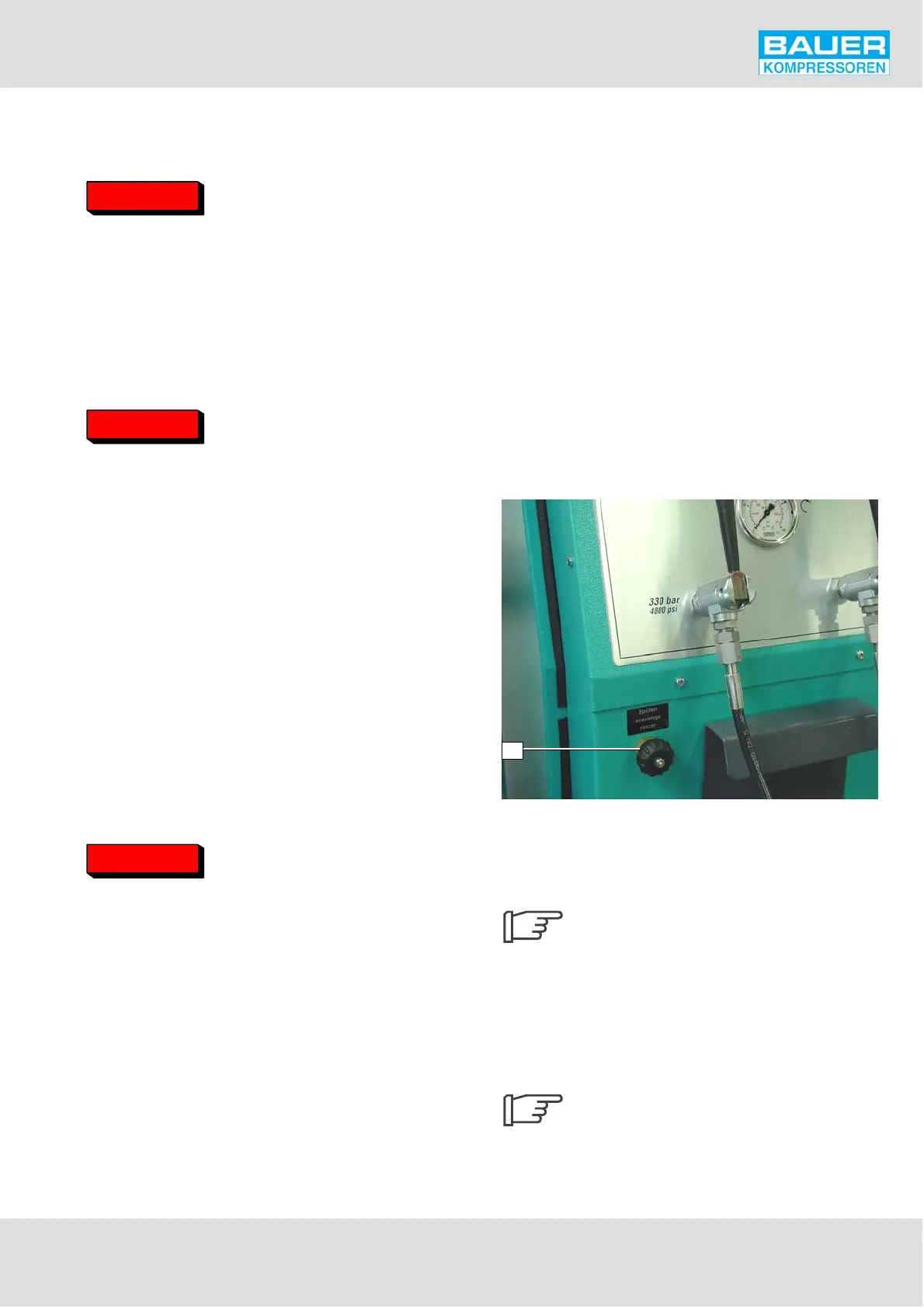
unit before connecting and filling the air bottles, i.e. let
the compressed air escape into the open air by opening the
scavenging valve (1, Fig. 97).
1
Fig. 97 Scavenging valve
2.5.4. Connecting the bottles
- Connect air bottle to filling valve (see Fig. 99).
On models of 300 bar rated filling pres
sure do not attach bottles unless rated for
this pressure (note pressure stamped on
tank neck).
- Air bottles with international filling connector can be
connected with filling adaptor (PN 08487-635) to the
German filling connector or with filling adaptor (PN
03147-635) directly to the filling hose (see Fig. 98).
The international connector is not per
mitted in Germany. In other countries it is
allowed only for pressures up to 200 bar
(2,850 psi). This filling connector cannot
be used on 300 bar (4,350 psi) models
due to constructive measures.


 To Next Page