CHC i83 User Manual 48
c. Where are the nearby NGS CORS stations? This will determine ‘Rapid Static’ or ‘Static’ availability.
C. OPUS-Rapid Static Requirements
a. Find the closest 9 CORS sites with available observations.
b. A minimum of 3 CORS stations within 250 KM are needed.
c. Your site must be within 50 km of a polygon created by the remaining available CORS.
d. If the eligible CORS count is low, check the past reliability of recent observations to ensure that there is a
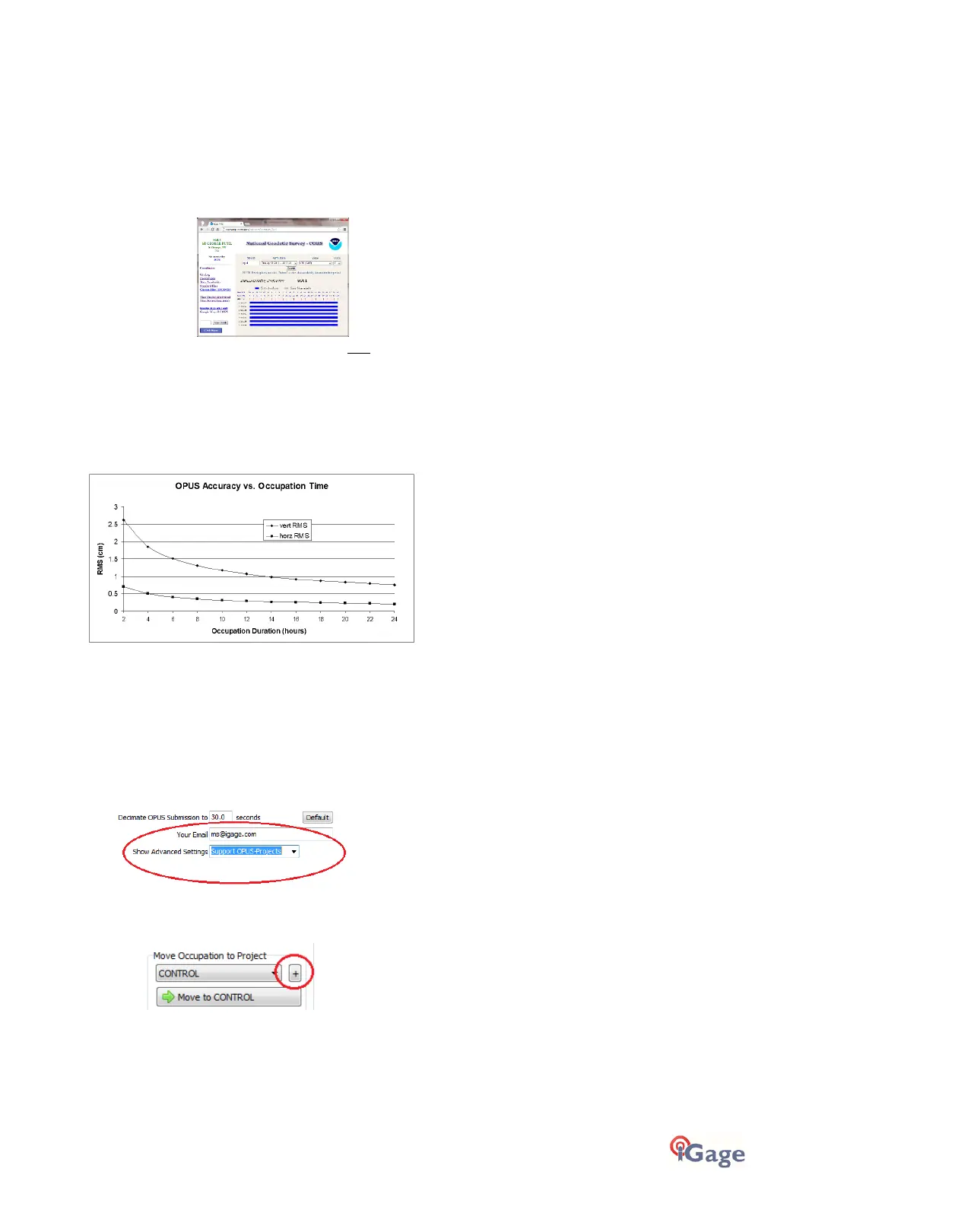
high probability of sufficient sites for OPUS-RS to compute a solution. Use the CORS ‘Data Availability’ to
check for recent observations:
D. Mission Planning: Satellite Availability and Network Planning
a. How many receivers will you use for simultaneous observations? If you are using OPUS-Projects, then
more receivers is better.
b. Checkout online ‘Mission Planning’ tools for U.S. satellite availability using reasonable masks (>15 degrees)
during collection periods. If there are any periods with fewer than 6 SV’s or PDOPS higher than 3, plan on
occupying points longer.
E. How long will you observe a site? Again:
F. Are your sites GPS compatible? Are there obstructions higher than 10 degrees?
Using OPUS-Projects
If you are contributing occupations to a registered OPUS-Project, the iGx tool can assist you when uploading files into
your project by automatically entering the NGS project ID:
1. Turn ON OPUS-Projects support. On the ‘Configuration’ tab, set ‘Show Advanced Settings’ to “Support OPUS-Projects”
or “Advanced”:
2. Add the NGS registered OPUS-Projects ‘Project Identifier’ supplied by your project administrator:
Click the “+” button


 To Next Page