55 CHC i83 User Manual
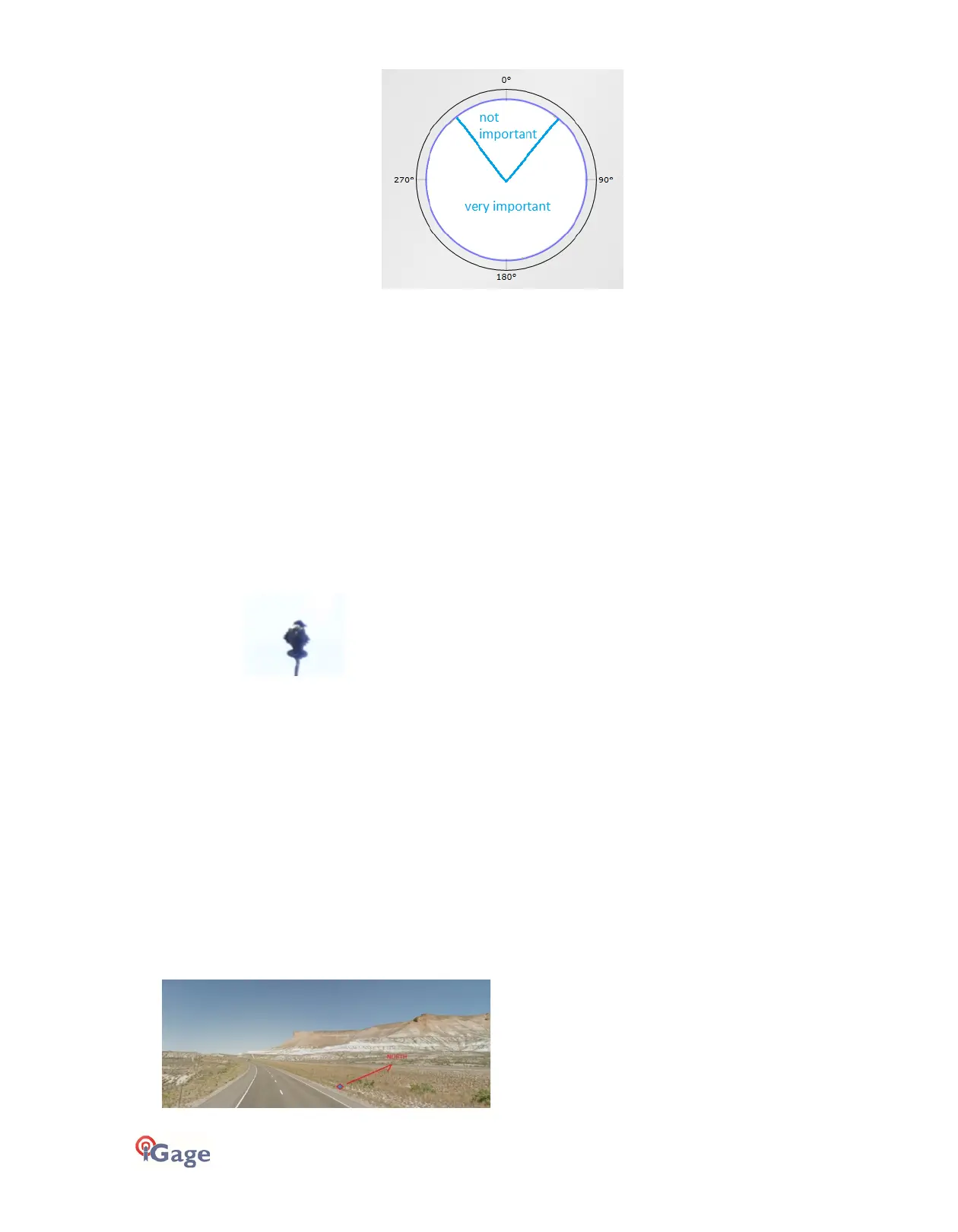
Obstructions to the North not important in North America
Note: OPUS will process observations down to 10° elevation so you should set your receiver to start tracking a few
degrees below 10°, or just allow it to track all the way to the horizon (0 degrees Elevation Mask.)
Attributes of a great GPS location for collection OPUS ready occupations:
• No overhead power lines.
• No trees: leaves on or leaves off.
• No power poles (wood or metal).
• No radar or radio paths that cross over the top of the receiver.
• No chain link fences nearby.
• Locations under busy landing paths are undesirable.
• No large ‘GPS reflective’ surfaces (metal roofs) nearby: avoid multipath.
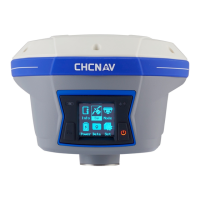
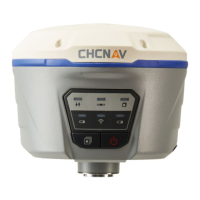
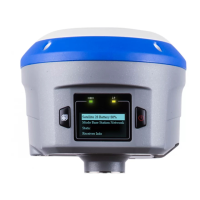
• Receiver facing correct direction: usually MMI (Man-Machine-Interface AKA the push buttons), antenna
connector or North fiduciary pointing to the North.
• The receiver mounted very securely on well braced, fixed-height tripod.
• No chance of giant birds sitting on your antenna during occupations:
This picture is an actual GIANT crow sitting on an actual CORS antenna!
• No chance of trucks higher than your antenna passing nearby during occupation
Yes, users get remarkable results in challenging locations all the time. And you may be lucky, but these are real rules,
and you should consider respecting them.
Worst Case Scenarios
All the sites presented below are actual customer sites (or in some cases slightly obfuscated locations to save
embarrassment.)
Remember that during times of low DOP (see the mission planning section of this document) you may get reasonable
OPUS-Static and OPUS-RS solutions at these challenging locations. Longer (3-hour) and very long occupations (over 8-
hours) may be dependable because the high-DOP conditions are bridged with times of good coverage. However, in
general, you should avoid the following scenarios.
Semi-Trucks and Trains
This bench mark is 3 feet north of the eastbound edge-of-pavement of I80 near Green River Wyoming:


 To Next Page