59 CHC i83 User Manual
At this location, on this day, any one-hour OPUS-RS occupation from 5:30 pm to 9:30 pm will certainly
fail
. However, a
one-hour OPUS-RS occupation from 11:30 am to 12:30 pm (or most of the rest of the day) will probably be
successful
.
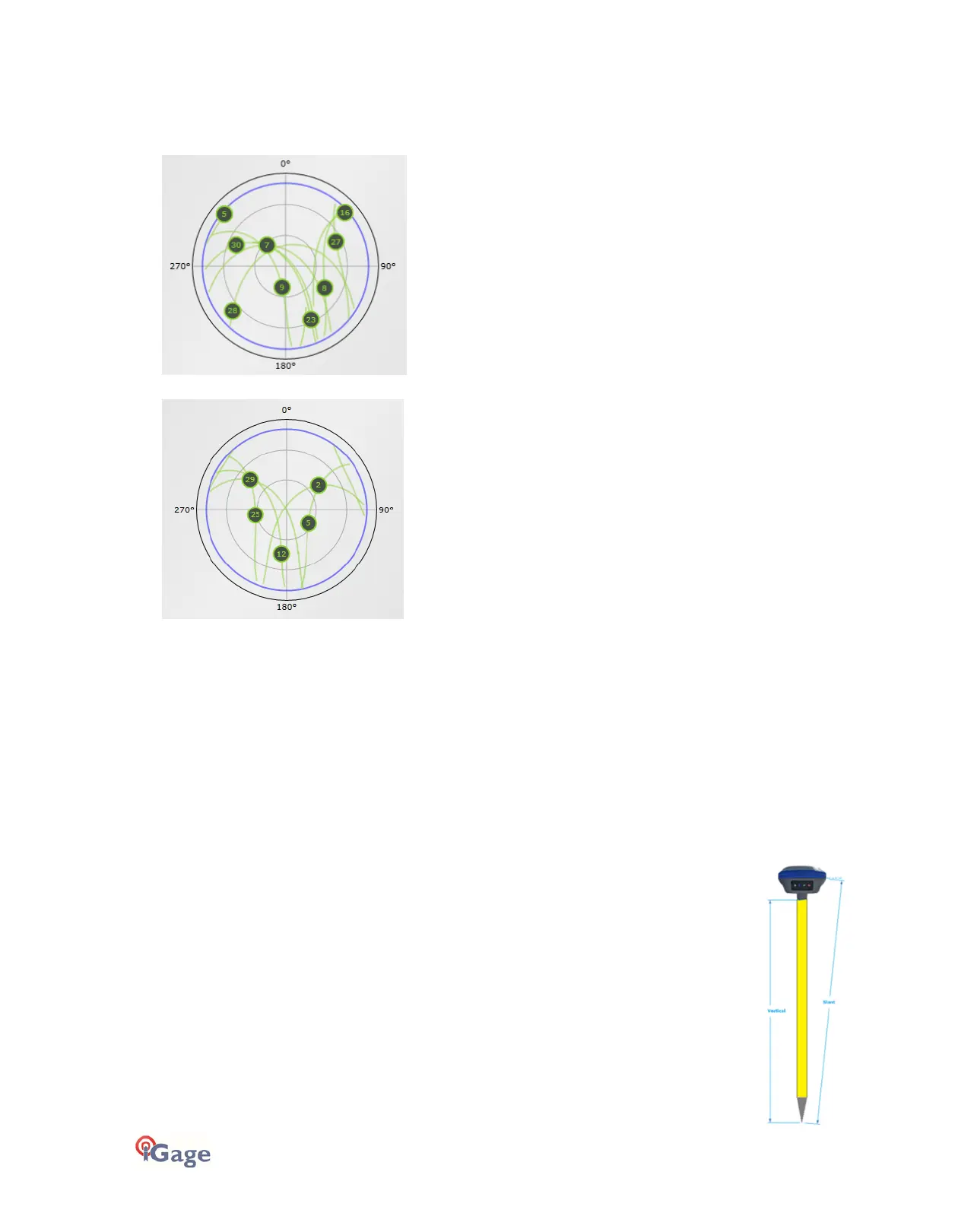
DOP is a function of how many and where the satellites are in the sky. We prefer more satellites, spread over a larger
portion of the sky, with one or more satellites in every quadrant:
11:30 am
Great
8:50 pm
Bad
One pitfall of OPUS-RS is very short occupations may entirely fall into a very high-DOP period. As you can see from the
DOP plot above, high DOPs rarely last for more than an hour and longer OPUS-Static occupations will usually have some
periods of low DOP and excellent coverage.
The change in satellite constellation, which determines PDOP is why a receiver will work one day and then not work in a
nearby location at a different time.
#11 Be Procedure Smart: avoid Blunders
Assuming that your receiver is in a location that is suitable for GPS observations, at a suitable time, there are several
procedural blunders that you can do to force a bad result:
• Mounting system is not level and receiver is not centered over the ground mark.
• Antenna height (HI) is wrong.
• Antenna is mis-rotated, doubling antenna compensation errors.
• Wrong antenna type is selected.
• No battery in head with external power
Use a Fixed Height Tripod, Get the HI Correct!
The #1 OPUS procedure failure is a blundered instrument height. The ONLY HI that OPUS will accept
is the vertical height above ground to the ARP (Antenna Reference Point) in meters.
If you use a tribrach, you are going to have to make a slant measurement and then reduce the slant
distance and SHMP (Slant Height Measurement Point) vertical offset to a metric vertical height. The
process is described on page 69
Error! Bookmark not defined.
in the ‘‘Slant Height’ to ‘Vertical
Height’:’ section of this User Manual.


 To Next Page