61 CHC i83 User Manual
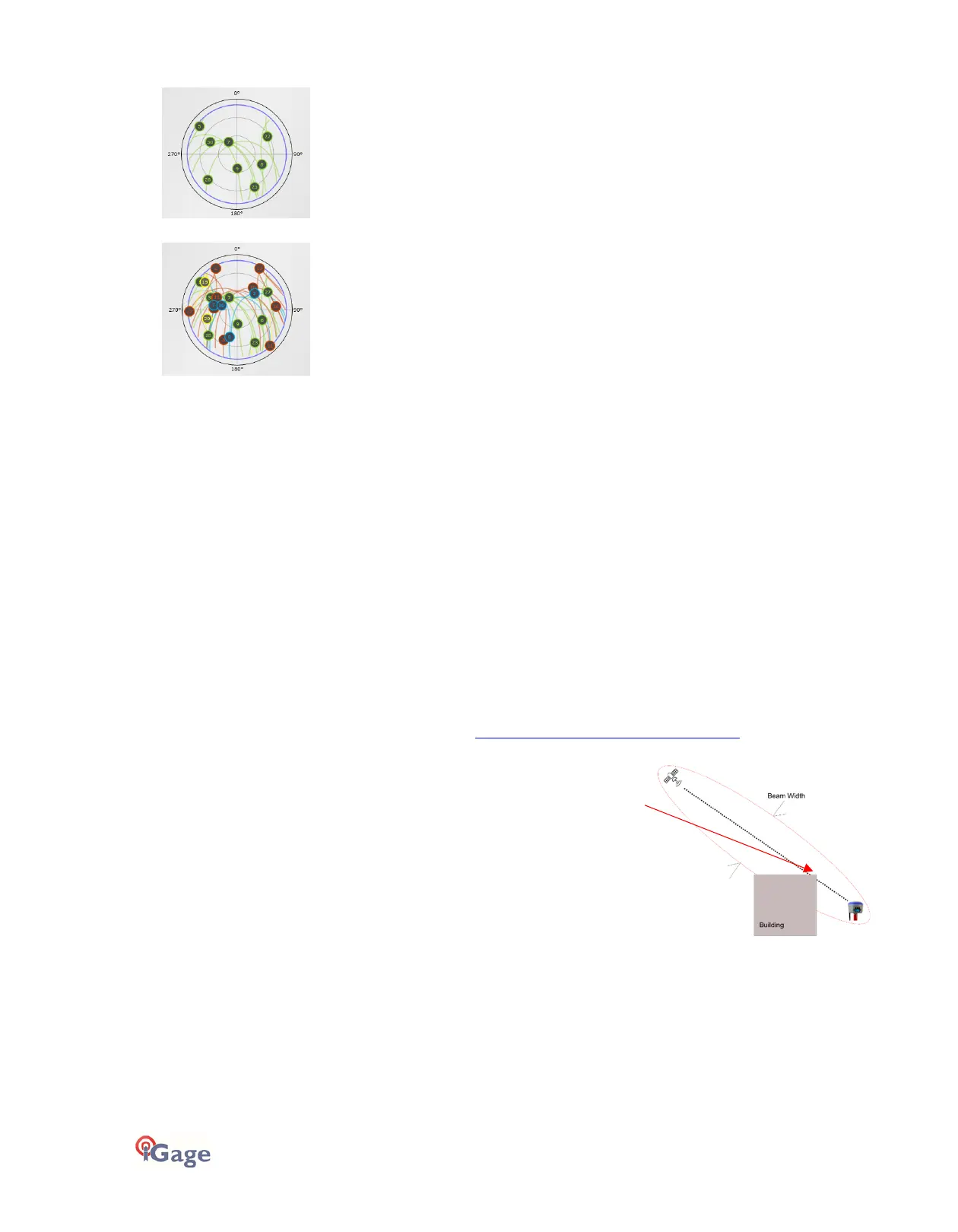
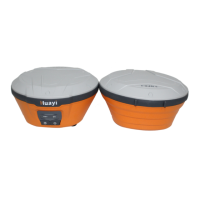
Compare these two sky plots (same time, same location):
GPS Only
GPS + GLONASS + Galileo + BeiDou
More satellites are better. More signals are better. Even though the receiver tracks GPS, GLONASS, Galileo and BeiDou
satellites, OPUS currently only uses GPS observations. So, a great constellation like the one on the right is reduced to the
minimal constellation on the left.
Baseline Distance
OPUS processes GPS baselines from your receiver all the way back to each individual CORS station. Typically, these will
be 45 KM (28 miles) to 150 KM (93 miles) baselines. In some areas the nearest CORS station might be 250 KM distant!
RTK processes the baseline from your RTK Base to your RTK Rover which typically will be less than 10 KM (6 miles.)
Short baselines ‘Fix’ more easily and have substantially less noise.
#13 Fresnel Zone Considerations
Most GPS users think of the radio path from their receiver to each of the satellites is like a small laser beam. This is
incorrect.
The GPS beam width is spread out in a cigar shaped area known as the ‘Fresnel Zone’.
Fresnel is pronounced with a silent-s: “Frenel”, named after French physicist Monsieur Fresnel.
Wikipedia has an excellent article on the Fresnel effect: https://en.wikipedia.org/wiki/Fresnel_zone; be sure to check
out the section on ‘Fresnel Zone Clearance’ mid-article.
The Fresnel effect explains why your GPS receiver will track a satellite which is fully
behind a building or ridgetop. The beam width is wide enough that a portion of the
signal reaches the GPS receiver, even though the beam’s center is fully blocked by
the building.
Tracking a satellite means that the satellite is ‘visible’ to your receiver, however just
tracking is not sufficient to accurately evaluate a carrier-phase position.
To compute an accurate position, your receiver needs a very clean signal with few
reflections, obstructions or delays. Any object blocking a part of the beam can be a
source of reflection, attenuation or delay.
Clear path means that you don’t just need a small opening in the trees for a laser beam to shoot through. You need an
opening in the trees large enough that most of the energy which is spread out over the Fresnel beam width reaches the
receiver with no obstructions.
How wide is the Fresnel beam along the path?
Much wider than you think!
Here is a beam-width chart for GPS L1 (1.575 GHz):


 To Next Page