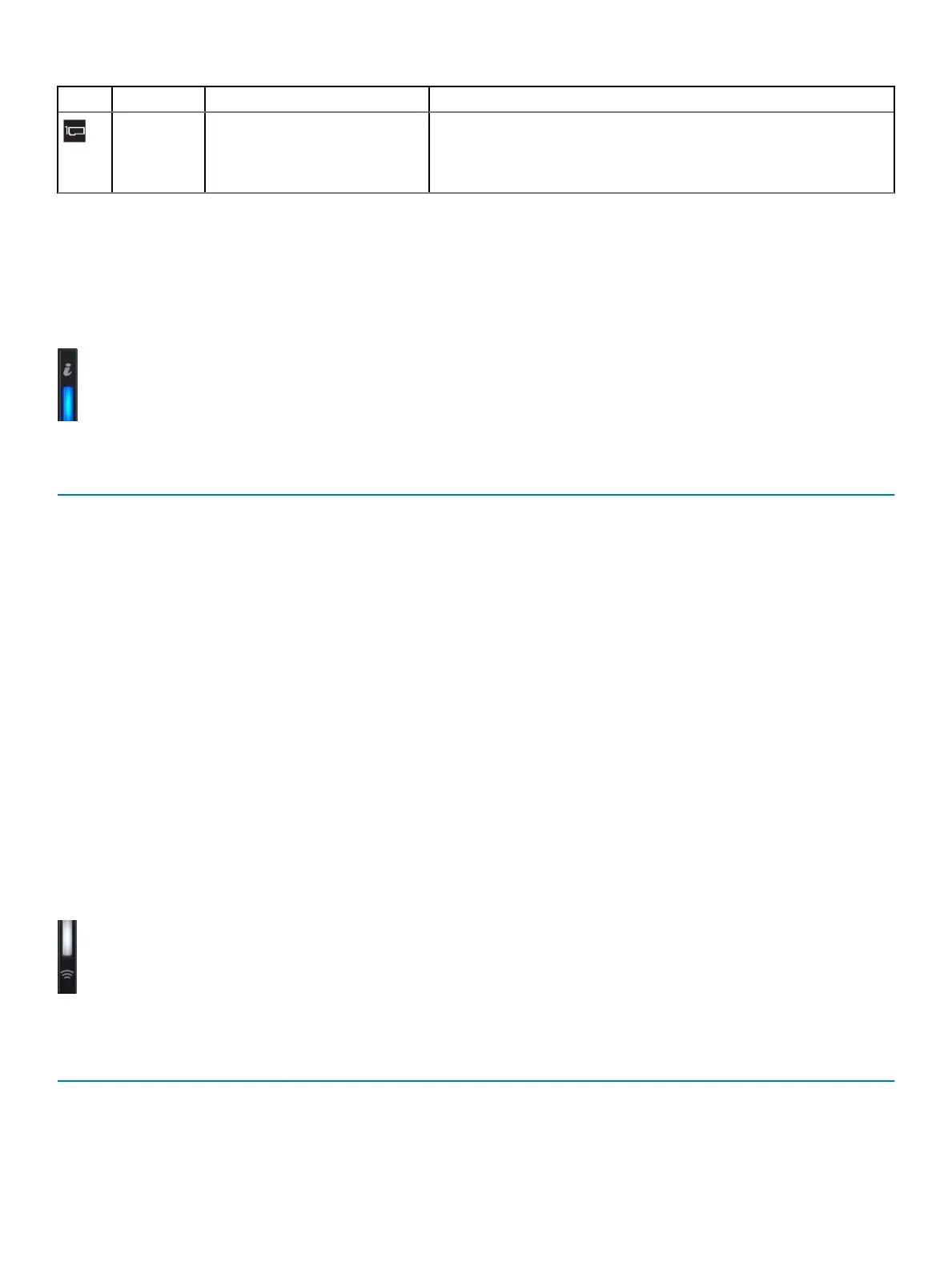
Icon Description Condition Corrective action
PCIe
indicator
The indicator turns solid amber if a
PCIe card experiences an error.
Restart the system. Update any required drivers for the PCIe card. Reinstall
the card.
If the problem persists, see Getting help.
System health and system ID indicator codes
The system health and system ID indicator is located on the left control panel of your system.
System health and system ID indicators
Table 6. System health and system ID indicator codes
System health and system ID indicator code Condition
Solid blue Indicates that the system is turned on, system is healthy, and system
ID mode is not active. Press the system health and system ID button
to switch to system ID mode.
Blinking blue Indicates that the system ID mode is active. Press the system health
and system ID button to switch to system health mode.
Solid amber Indicates that the system is in fail-safe mode. If the problem persists,
see the Getting help section.
Blinking amber Indicates that the system is experiencing a fault. Check the System
Event Log or the LCD panel, if available on the bezel, for specic error
messages. For information about the event and error messages
generated by the system rmware and agents that monitor system
components, see the Error Code Lookup page at qrl.dell.com.
iDRAC Quick Sync 2 indicator codes
iDRAC Quick Sync 2 module (optional) is located on the left control panel of your system.
iDRAC Quick Sync 2 indicators
Table 7. iDRAC Quick Sync 2 indicators and descriptions
iDRAC Quick Sync 2 indicator
code
Condition Corrective action
O (default state) Indicates that the iDRAC Quick Sync 2
feature is turned o. Press the iDRAC Quick
If the LED fails to turn on, reseat the left control panel
ex cable and check. If the problem persists, see the
Getting help section.
Dell EMC PowerEdge R640 system overview 15




 To Next Page