Control Unit IV Reference Manual Product Description
529-0004 Ver.3 1-7
1.3.4 Redundancy system
Connecting two identical Control Units ensures system redundancy, allowing the backup unit
to take over if there is a problem with the master unit. This feature provides greater service
reliability. The master and backup units must have exactly the same firmware version and
setup (see Chapter 3 for setup).
1.3.5 Diagnostics
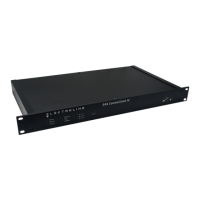
The Control Unit includes nine LEDs on the front panel:
POWER
,
MASTER
,
STATUS
,
BATTERY
,
FSK
,
MODEM
, and three
RX
/
TX
LEDs. The LEDs are used to monitor the Control Unit’s
operation. A complete troubleshooting table including the use of the LEDs to diagnose
problems can be found in Chapter 6.
At startup, the Control Unit’s firmware performs a series of self tests. When a terminal is
connected to the unit, the user can view the startup screen. If a system is in error, a message
or warning will appear on screen. A list of error messages is included in Chapter 6.
If an error occurs, the Control Unit’s reset button can be pushed to restart the unit without
powering off. The reset button returns the Control Unit to its initial state before the reset and
does not affect the information stored in its memory.
1.3.6 Upgradability
The Control Unit’s firmware, or operating system, is stored in the unit’s flash memory. The
unit comes with an upgrade program (CU4UP) on CD-ROM for installing a new version of
the firmware in the unit’s flash memory. Use this program only when you need to upgrade
the firmware (see Chapter 5 for upgrade instructions). Normally, a firmware upgrade is only
required if it has been recommended by Electroline’s technical support staff.
In addition to software and firmware upgrades, the Control Unit’s hardware can be upgraded
through the expansion slots on its main board (see section 1.4.2 for information on expansion
slots).


 To Next Page