TRANSIENT3000
10/162
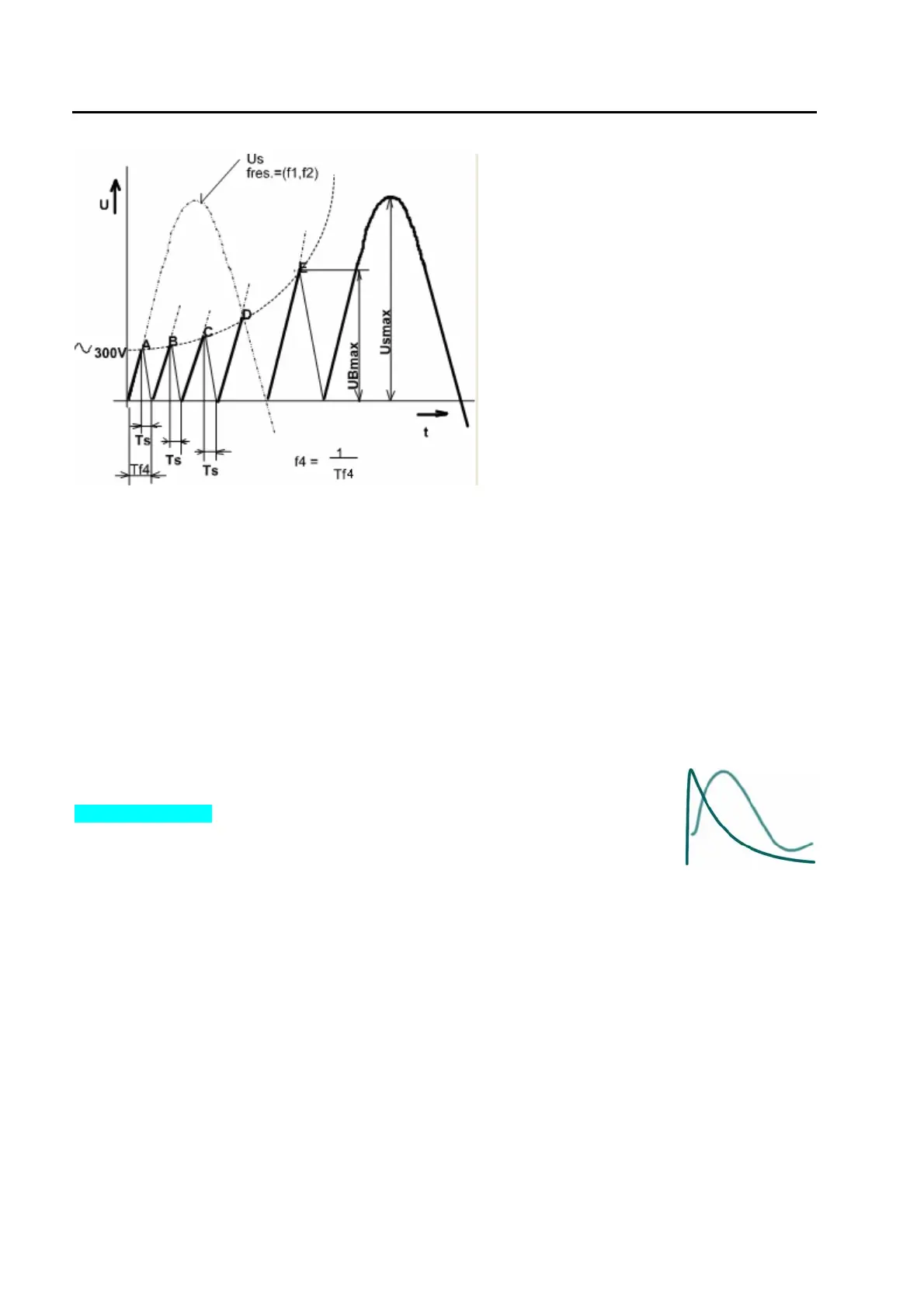
Figure: 1.0.1.2
The parameters which define the
burst are:
- Rise time of the spike Ts in ns
- Repetition frequency f4 in the range of kHz up to MHz
- Energy, some mJ
- Voltage amplitude UBmax. up to some kV
- Duration of a burst several milliseconds
The different EFT sources generate different burst waveforms. A typical burst waveform is shown in the
figure above.
The impedance of the EFT source is generally high, therefore the capacitance of connected cables
influences the rise time.
1.1.3 Indirect lightning SURGE
SURGE are transients with a high energy, relatively low frequency content up to some
kV
.
IEC 61000-4-5 Ed.2
Lightning is a daily event and occurs about 8 million times in approximately 44,000 storm centres
throughout the world. That is in the order of 100 discharges per second. Measuring and recording
equipment in aircraft registers one lightning strike for every 1,000 flying hours.
Product assembly and finishing in many industries depends on modern electronics. The most frequent
cause of damage is overvoltage, caused either by switching action in the equipment itself or by
atmospheric discharges such as lightning. In order that the overvoltages do not destroy the electronic
equipment, protection elements and circuits are placed at the inputs and outputs of electronic equipment.
Consumer electronic devices, such as antenna ports on television sets, telephones, faxes, can also be
influenced by atmospheric discharges. The disturbances are mostly tolerable because of their relatively low
occurrence. To protect such equipment from damage protection elements and circuits are installed. Tests
must be carried out to determine whether these protective circuits are really effective.
Beside lightning, switching action can also generate high energy impulses.


 To Next Page