TRANSIENT3000
59/162
5.5.3 Test set up SURGE
Ports which must be tested:
AC/DC power supply, signal, data and I/O lines; earth connections
Coupling path:
Unlike the EFT and ESD tests stray capacitance are not important here. The frequencies contained in the
SURGE impulses are lower. The galvanic and mutual coupling are dominant. The cable lay-out and the test
set-up is therefore uncritical. The test results are easily reproduced.
Test set-up:
What must be tested?
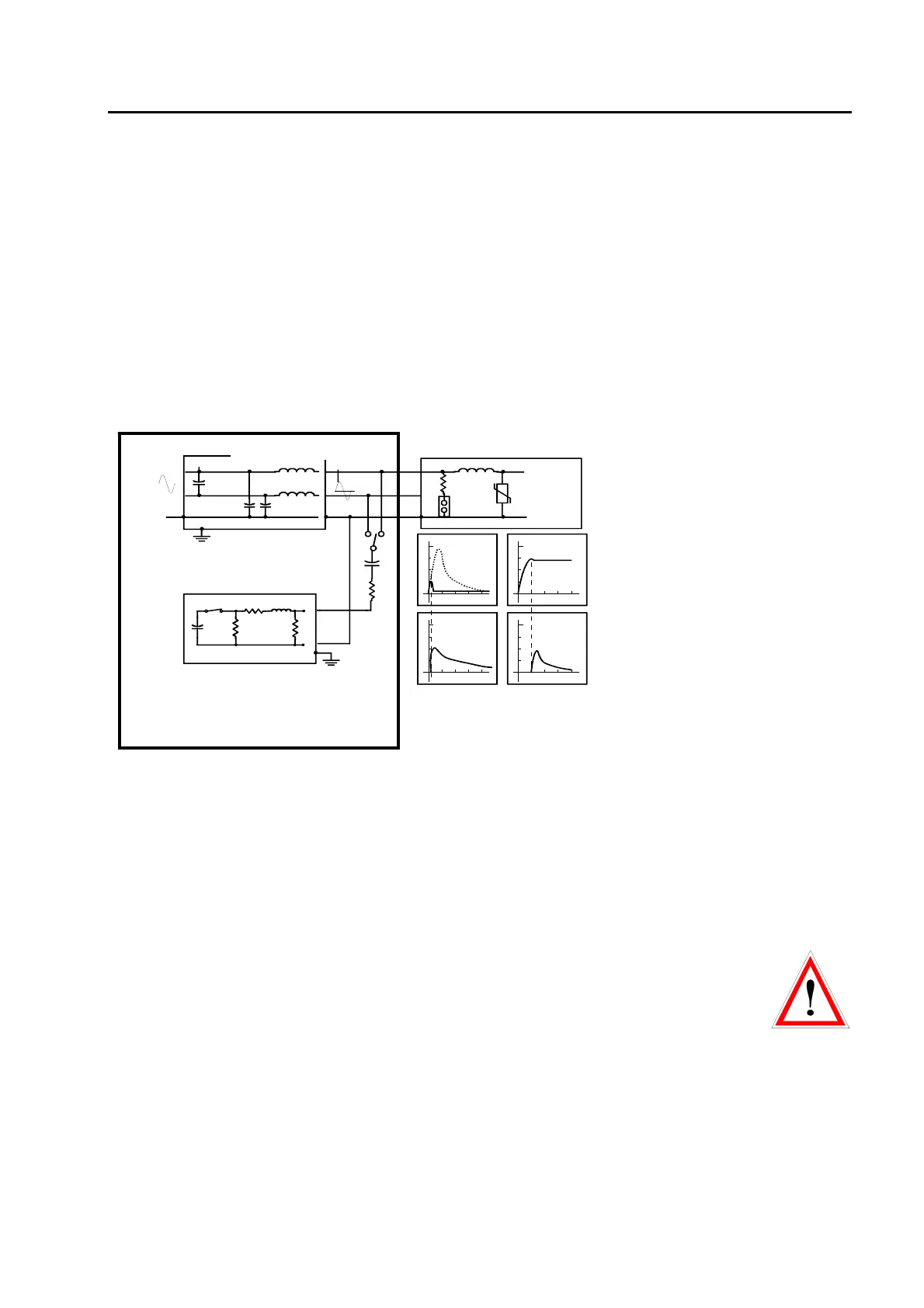
Protection circuit for inputs, and outputs as shown in the figure below.
Entkopplungsfilter
Surge generator
EUT
figure 5.4.3
Superimposing SURGE pulses onto power lines is carried out using a capacitance between the tester and
the power line. With the SURGE test, the effectiveness of the protection circuit will be tested. The residual
voltage after the protection circuit could affect the electronic parts of the EUT.
The SURGE test is a single discharge, as for ESD. The considerations regarding single discharge which
were made for the ESD discharge also apply here. Synchronisation with the power line frequency is
important, and must be considered.
With the proposed current injection method, the bonding of screen and earth connections can be tested.
Safety:
The SURGE pulses can be dangerous for persons. The EUT and its cables should not be touched during
SURGE EMC tests.
In case of a breakdown in the EUT, it must be remembered that high currents can flow from the power
supply.
residual voltage which could
affect the electronic circuitry
Voltage
Current
====>
coupling
ca
acitance
primary
protection
secondary
r
i
n
TRANSIENT-3000
Back filter


 To Next Page