Chapter 6 Fastening Operation
PAGE 6-30
•If the rate start torque (angle) cannot be detected during fastening operation, the rate judgment
will not be performed.
•Under the following conditions, the torque (angle) at the end of fastening is judged as the rate
end torque (angle).
•If the set values are set so that rate start torque (angle) > rate end torque (angle).
•If the rate end torque (angle) cannot be detected during the fastening operation.
. When the increase in angle from the measurement start point to the end point is “0” deg, the
operation varies depending on the firmware version.
·Before ver1.304: The rate calculation becomes "0" and rate is not judged
·Ver1.305 or later: The rate calculation becomes the maximum and the rate judgment is rate
high NG
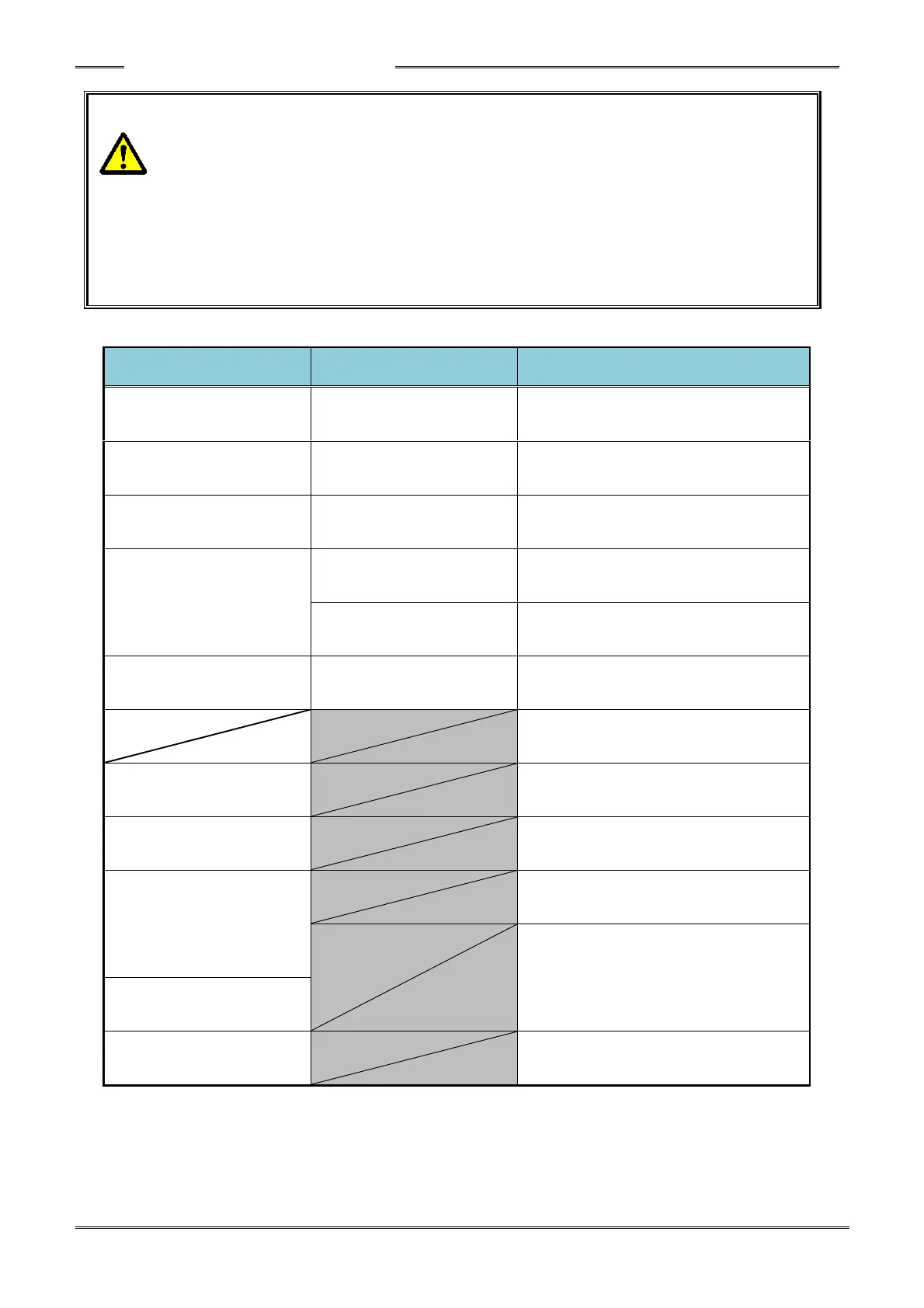
●FUSION/HFC3000 Fastening Parameter (Rate) Correspondence Table
FUSION
Fastening Parameter
HFC3000
Fastening Parameter
The torque value sets the start point of
measurement of torque rate 1.
15 1st Torque
(1st Rate End Torque)
The torque value sets the end point of
measurement of torque rate 1.
The torque value sets the start point of
measurement of torque rate 2.
18 CROS Torque
(2nd Rate End Torque • 3rd
Rate End Torque)
The torque value sets the end point of
measurement of torque rate 2.
The torque value sets the start point of
measurement of torque rate 3.
13 Standard Torque
(3rd Rate End Torque)
The torque value sets the end point of
measurement of torque rate 3.
The angle value sets the start point of
measurement of torque rate 1.
23 1st Angle
(1st Rate End Angle)
The angle value sets the end point of
measurement of torque rate 1.
The angle value sets the start point of
measurement of torque rate 2.
24 CROS Angle
(2nd Rate End Angle • 3rd Rate
Start Angle)
The angle value sets the end point of
measurement of torque rate 2.
The angle value sets the start point of
measurement of torque rate 3.
22 Standard Angle
(3rd Rate End Angle)
The angle value sets the end point of
measurement of torque rate 3.


 To Next Page