Installation Instructions
Seite/Page 60 Panda_5000i_PMS_eng.R01 - Kapitel/Chapter 5: Installation Instructions 9.12.10
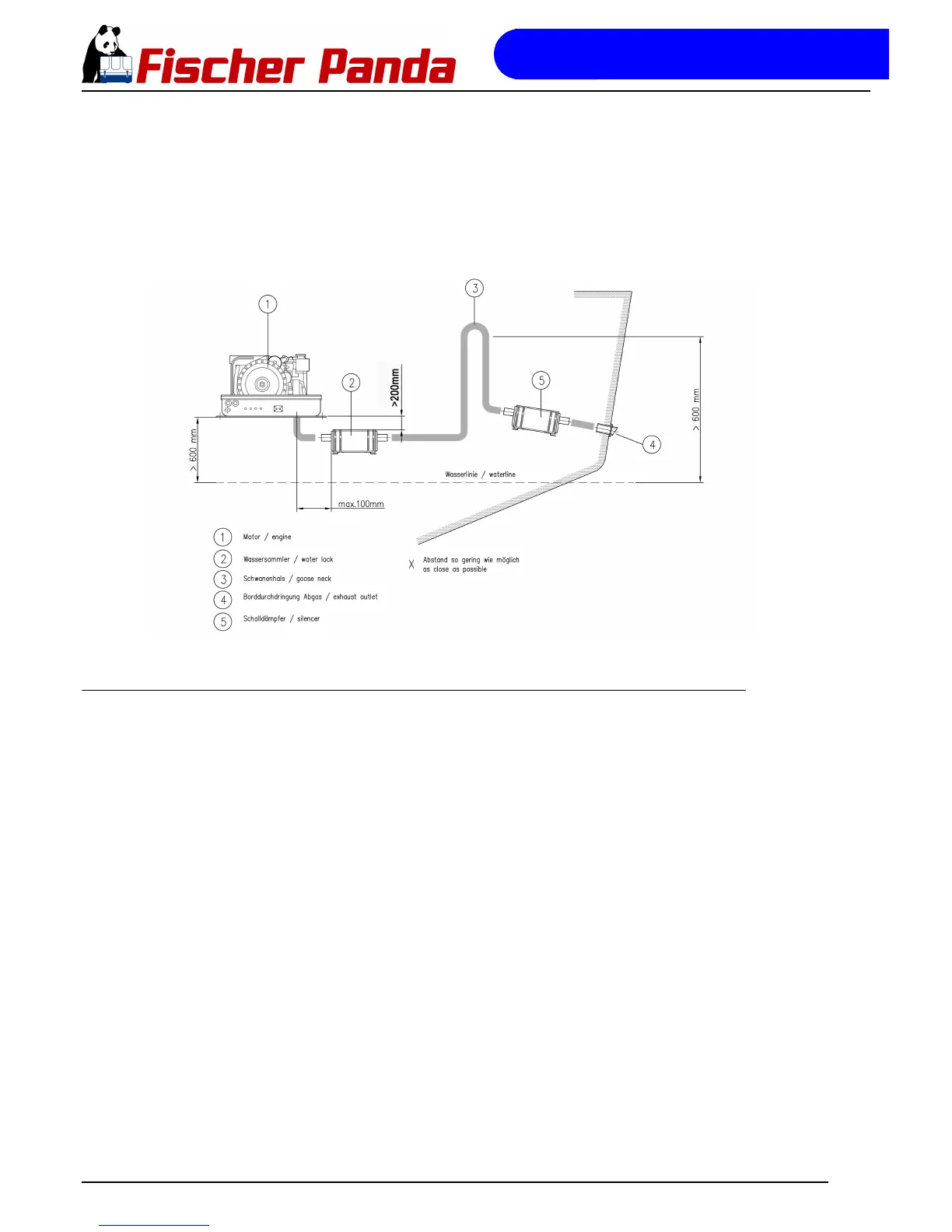
50 mm). The water lock must be installed at the lowest point of the exhaust system. An optional noise insulated
water lock can also be installed. The exhaust hose descends from the capsule to the water lock. Then the hose rises
via the "goose neck" to the silencer (see drawing). The goose neck must be vertical and sit preferably along the
ship's keel centre line. The exhaust system must be installed so that the back pressure inside the exhaust does not
exceed 0.4 bar (6 psi) and total length does not exceed 6 m (20 ft.).
Exhaust diameter see “Diameter of conduits” on Page 105.
Fig. 5.6.1-1: Installation example
5.6.2 Installation of the water collector
Unfortunately, it can occasionally occur that, because of an disadvantageous mounting position of the water collec-
tor, sea water gets into the diesel engines’ combustion chamber. This disables the diesel engine by irreversible
damages. Quite frequently, this leads to discussions during which the parties involved in the yachts’ construction or
the installation of the generator have to explain themselves.
One point in this situation can be clarified definitely:
If sea water gets into the inner section of the engine, this is not possible due to constructional defects of the genera-
tor or to malfunctions on the engine itself. It can only reach the combustion chamber via the exhaust duct and thus
get into the engine.
Thereby, the position of the generator and the water collector, as well as the arrangement of the coolant and exhaust
ducts plays the decisive role.
If the water collector is arranged in an unfavourable position, the coolant flowing back in the exhaust duct can rise so
high, that it reaches the exhaust stack. Since at least one discharge valve is always open when the engine is shut
off, the sea water has free access to the combustion chamber. By capillary action, this sea water then flows past the
cocks and even reaches the engine oil in that way. (In fact, a surprisingly high oil level is a first indication of an upco-
ming catastrophe.)
If an usual high oil level can be detected and/or the oil is of a greyish colour, the engine must not be used
anymore. This is a certain sign for coolant that got into the oil pan. If the engine isstarted under these con-
ditions, the water and the oil are mixed into an emulsion. The the oil will quickly become so viscous that one
will have to call it a paste. In this phase the fine oil ducts are blocked and a few moments later the machine
gets destroyed because of insufficient lubrication. Before this happens, an immediate oil should be made.
(Since the water can only reach the engine via the combustion chamber, it can be assumed that the com-
pression rings will start to corrode. These effects have to be discussed with an engine expert. It will cer-
tainly be reasonable to immediately inject plenty penetrating oil through the intake stack and to slowly turn






 To Next Page