User Manual NTU Orion 2
11
Notations in the figure:
• ATS: a private automatic branch exchange;
• E1: a 2048-kbit/s digital flow structured according to ITU-T Rec. G.704;
• Management PC: a personal computer used to configure the system;
• Vlan Switch: a switch of Ethernet packets supporting the Vlan function (IEEE 802.1q);
• VoIP: devices of IP telephony (VOICE over IP);
• Ethernet Network: local Ethernet network;
• Orion2 LTU: FlexDSL Orion2 line termination unit;
• Orion2 NTU: FlexDSL Orion2 network termination unit;
• RGNo2: FlexDSL Orion2 regenerator.
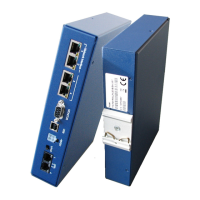
The devices of this family have different mechanic designs: SubRack – a unit to be inserted into
a 19’’ FlexGain shelf; MiniRack – a 1U (44.5 mm) unit to be inserted into a 19’’ cabinet; Stand
Alone – a desktop unit; IP-67 – a unit in a water-proof plastic or silumin housing (class IP-67);
XCVR – a unit to be inserted into a hermetic steel housing.
The devices have the following possibilities for monitoring and management:
• Local management and control of remote devices and regenerators – VT 100;
• Local management and control of remote devices and regenerators – Telnet session;
• Operation in complex networks under the unified management system – support of SNMP.
The use of the Flash memory as the ROM provides an easy upgrade of the software.
xDSL modems are powered from a grounded primary DC source (38 … 78 V) or remotely.
Modems are designed to be used in-doors under the following environmental conditions:
- temperature of ambient air – from -5 … +45°C;
- relative air humidity – from 5% … 85% at +25°C.
3.2 Main features of FlexDSL Orion 2 devices
FlexDSL Orion 2 modems represent the next generation of modems of the FlexDSL Orion
family and have the following features:
1. A new type of line encoding – TC-PAM32 (TC-PAM16 is also supported).
2. Duplex data transmission over one symmetrical pair at 5.7 Mbit/s.
3. Simultaneous transmission of the TDM traffic and Ethernet data.
4. The 802.1q protocol.
5. Different ways of system configuration (for example, remote configuration of devices via
Telnet).
6. Embedded WEB interface.
7. The SNMP protocol.
8. Possibility of storing several configurations in the device’s EEPROM in order to download
the previous settings of the system.
9. Two levels of system users: administrator and user, protected with passwords.
10. The use of the modern circuit printed boards, chips and components.
11. Extended reliability of the equipment.


 To Next Page