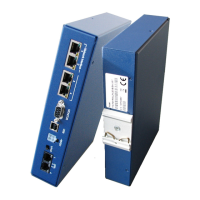
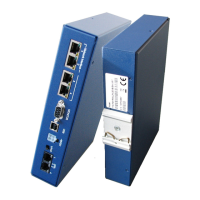
User Manual NTU Orion 2
94
4.6.5.36 <GATEWAY X.X.X.X> command
The <GATEWAY X.X.X.X> sets the default IP address of the router.
4.6.5.37 <NETMASK X.X.X.X> command
The <NETMASK A.B.C.D> command sets the subnet mask of the modem.
4.6.5.38 <VID [1-8] ID> command
The
<VID [1...8] ID> command sets VID for the VLAN with the number 1…8 equal to the ID
parameter. ID=1...4094.
8 VLANs are supported by the device, and available VID numbers assigned to the VLAN lie in
the range from 1 to 4094. VID as well as QoS are an attribute of the VLAN packet.
4.6.5.39 <V2T {[VIQ] [QoS]}|OFF > command
The <V2T> command allows to enable / disable the second (stacked) VLAN tag for the INT
interface.
Parameters:
VID VLAN identifier for the second VLAN tag. Note, that it is not the VLAN number (1..8).
The use of any VID in the range is possible without restrictions.
QoS Quality of Service value for the second VLAN tag.
The INT interface always works in access mode and adds/removes one VLAN tag, defined with
INTERFACE INT VLAN {xx} and INTERFACE INT QOS {x} commands.
The second VLAN tag for the INT interface is needed when LAN port operates in Access mode
and the management frames comes already tagged to this port. In this case another VLAN tag
will be added by the LAN port itself and management frame will actually have 2 tags. The tag
that the LAN port adds is the first VLAN tag. The original tag becomes the second tag.
+----------+---------+-------------+-------------+----------+--- ... ----+
| DEST MAC | SRC MAC | 81 00 qv vv | 81 00 qv vv | Type/Len | frame data |
+----------+---------+-------------+-------------+----------+--- ... ----+
\ First Tag / \ Second Tag /
4.6.5.40 <TRAPIP ADD/DEL X.X.X.X> command
The
<TRAPIP ADD X.X.X.X> command adds the IP-address X.X.X.X to the SNMP-trap list.
The
<TRAPIP DEL X.X.X.X> command deletes the IP-address X.X.X.X from the SNMP trap
list.
The list should contain no more than two IP addresses.
4.6.5.41 <COMMUNITY> command
The
<COMMUNITY> command sets the SNMP community parameter used to authenticate
incoming and outgoing SNMP traps: incoming requests to write and read and outgoing answers
to requests and outgoing traps.
After typing COMMUNITY, an invitation is displayed to enter the community parameters.


 To Next Page