User Manual NTU Orion 2
23
At the same time, while for a two-channel system the replacement of channels is trivial in the
case of contingency, in tre- and four-channle systems different variants are possible. However,
any system with the reservation mode follows a strict logic of channel substitution because by
default the system operates under conditions of incomplete data transmission, i.e., unreliable
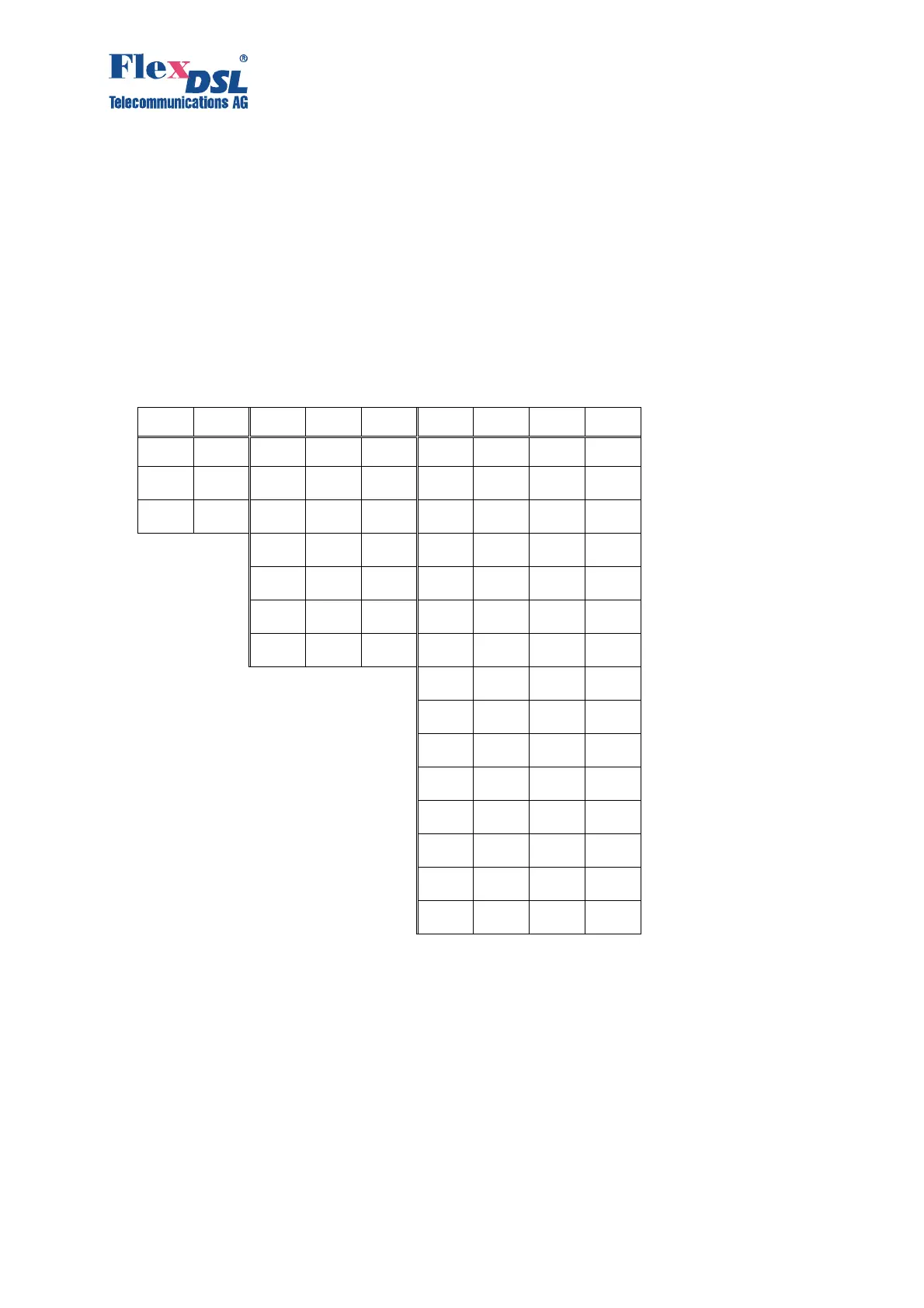
communication. Therefore, below we present a table of channel reservation, which should be
used by all devices in the case of contingencies.
The table for four DSL channels is constructed based on the assumption that communication is
lost frequently in one channel, while communication in two channels occurs less frequently. In
this case, loss of communication occurs successively, i.e., first one channel fails and then the
other channel fails. Therefore, following the rules of channel substitution will allow one to
minimize the number of channel substitutions (especially high-priority channels) in cases of
contingencies. This will minimize the losses of data during channel switching. Tables for two
and three channels are based on the same assumption, but they are simpler.
DSL1 DSL2 DSL1 DSL2 DSL3 DSL1 DSL2 DSL3 DSL4
1 2 1 2 3 1 2 3 4
1 Down 1 2 Down 1 2 3 Down
Down 1 1 Down 2 1 2 Down 3
1 Down Down Down 2 Down Down
Down 2 1 1 Down 3 2
Down 1 Down 1 Down 2 Down
Down Down 1 1 Down Обр. 2
1 Down Down Down
Down 2 3 1
Down 2 1 Down
Down 2 Down 1
Down 1 Down Down
Down Down 2 1
Down Down 1 Down
Down Down Down 1
Figure. 3.7 Examples of reservation of systems with two, three and four xDSL channels.
The <RESERVE> command is used to configure reservation.


 To Next Page