44 Programming terminals
Anti-intrusion control panels
The options listed above allow you to indicate the output-function type.
Note
A declaration as to the type of output which is incoherent with the output itself may cause malfunction.
MONOSTABLE
When a “Monostable” output receives an activation signal, it will remain active (On) for the
programmed time, regardless of the status of the event which caused its activation.
For some events there are conditions that can force the early deactivation of the activated
monostable outputs.
DO NOT
DEACTIVATE ON
RESET
If the option is activated, the output will not reset when the event that refers to it ends. It is
useful to activate the output with one event and deactivate it with another.
This option applies to “Bistable” outputs only. When a bistable output has this option enabled,
its selection as an output when an event is restored generates the output reset and not its
activation (refer to Chapter 12 Programming events).
This option is useful when you want to create "memory" events, the occurrence of which is
always signaled by the referenced output. In this case, the output is deactivated by a different
event which restores it directly to standby (resets the output).
For example, set:
- activate this option for the OC1 output
- associate the OC1 output to the occurrence (activation) of the “AC Mains failure”
event
- associate the OC1 output to the restoral of the “Valid code” event for “CODE 1”
In the event of Mains failure the output will activate but will not deactivate when the Mains
failure condition clears. The output will be deactivated only when recognition of the “CODE 1”
event occurs
SWITCH
If this option is enabled, each time an output activation command is carried out the output will
switch status. Therefore, if it is deactivated it will activate and vice versa.
However, each time you execute a “deactivate output” command, the output will always
deactivate.
In order to use this feature with the shortcuts, it is therefore necessary to use the “Activate
output” shortcut.
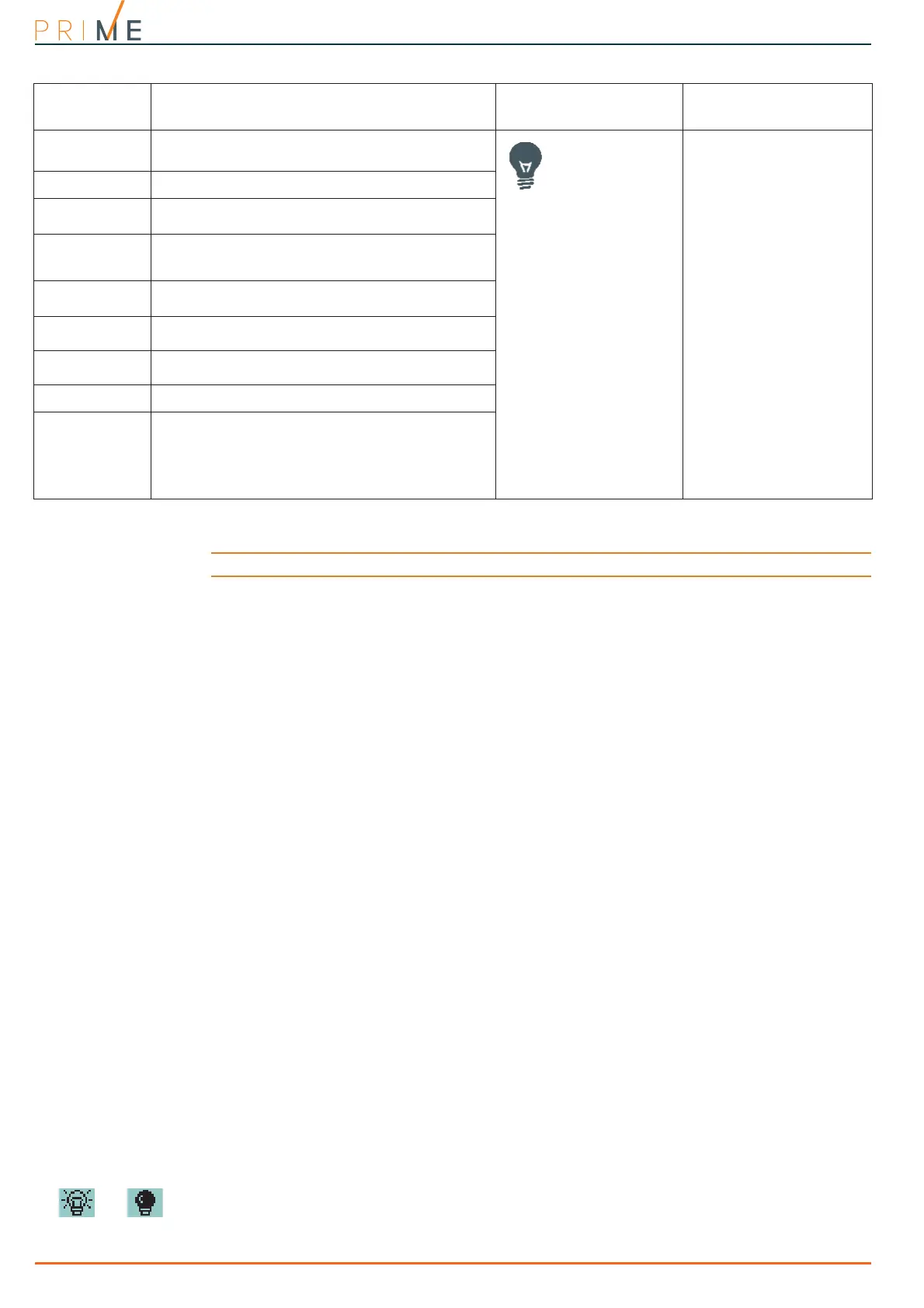
OFF ICON
Exclusively via software, in the programming page of the single output, it is possible to select
the ON and OFF icons, to be chosen from those available.
These icons will be shown on LCD keypads if On or Off shortcuts are programmed on any
function key.
Codes
Clicking on the Codes option in the table opens a
window containing a list of user codes which can
activate the output.
Not available
Normally closed
By selecting this option, the output will be electrically
closed during stand-by status.
Outputs, selected
outputs, Options
Outputs, "output", Op-
tions,
Monostable
This option makes the output a “monostable” output.
Buzzer - beep
1KHz
When the output is activated, it will generate a 1Khz
signal. This can be used to drive a buzzer.
Buzzer (beeper)
Flasher - 0.5s ON
and 0.5s OFF
When the output is activated, it will generate an
intermittent signal (0.5 sec ON and 0.5 sec OFF). This
can be used to drive a visual signalling device.
Flashing
Do not deacti-
vate on reset
The output will not restore when the activating event
ends.
ON afterRestoral
Switch
Each time an output activation command is executed,
it is switched.
Dimmer
The dimmer output and the power supply from the
terminals can be adjusted by the user.
Relay use
The output will operate as a relay output.
Use relay
Interlocked
If enabled, this option inhibits the contemporary
activation of the associated terminals.
It can be enabled only for terminal T01, which will
automatically activate the option for the associated
T02, and terminal T03, which will automatically
activate the option for the associated T04.
Table 6-7: Output parameters


 To Next Page