2011-07-01/00561073 [SCR Power Controller TYA202] 75
6 Special device functions
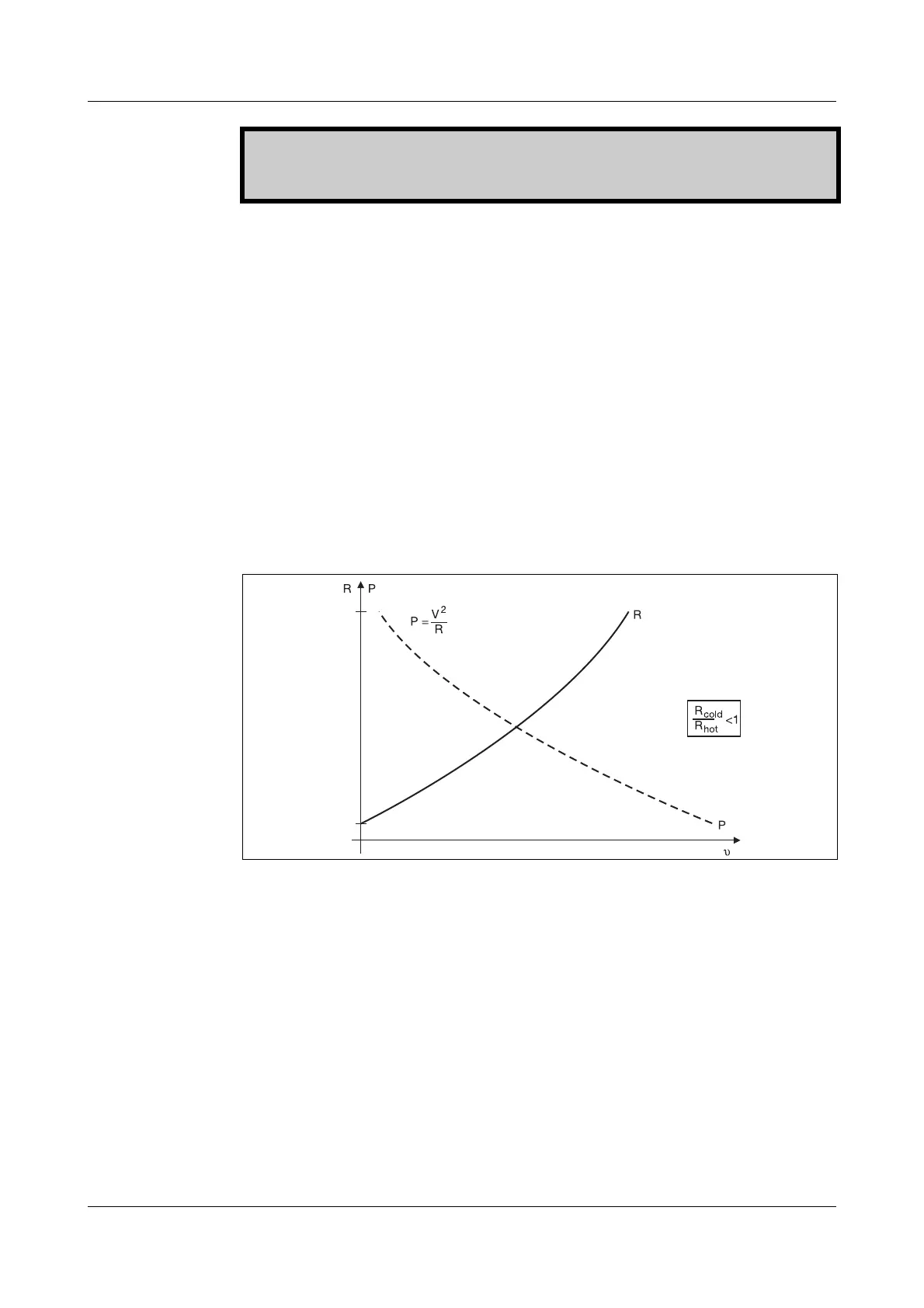
Heating elements that have a positive temperature coefficient (TC), i.e. where
the electrical resistance increases with increasing temperature, are
usually driven from a power controller that incorporates a subordinate U
2
control () (Figure 1).
These are resistive materials such as
- Kanthal-Super
- tungsten
-molybdenum
- platinum
- quartz radiators
Their cold resistance is substantially lower than their resistance when hot (by a
factor of 6 ... 16). These heating elements are usually run at temperatures
above 1000 °C.
Figure 1: Heating element with a positive TC
Power controllers need current limiting for the starting phase. The constant
current and the increasing resistance mean that, initially, the power in the
heating element increases in proportion to R, since the power P = I
2
· R.
When the current falls below the preset limit value, the current limiting is no
longer effective, and the power controller operates with the subordinate U
2
control, i. e. if the resistance continues to increase, the power fed to the
heating elements falls, since the voltage is held constant:
P
load
= automatically becomes smaller.
This effect supports the entire control loop. As the furnace temperature rises
towards the set value, the power fed to the furnace is reduced (for a given load
voltage), so the power controller itself slows the approach to the set point
(6)
P
Load
input signal of power controller (0 ... 20 mA)


 To Next Page