2011-07-01/00561073 [SCR Power Controller TYA202] 77
6 Special device functions
Looking at the power equation P = I
2
· R, we can see that an I
2
control has the
same regulatory effect on the power as already described for the U
2
control.
In other words, by regulating a constant current while the temperature rises,
the power in the process is automatically reduced as the resistance falls.
P control Power control (P control) is a continuous regulation of the product U · I, the
power. In this case, there is a precise linear relationship between the output
power and the level of the signal input ( e.g. 0 ... 20mA) to the SCR power
controller.
A typical application of this type of subordinate control is for regulating heating
elements which are subject to long-term aging combined with a temperature-
dependent change in resistance, as is the case with silicon carbide elements
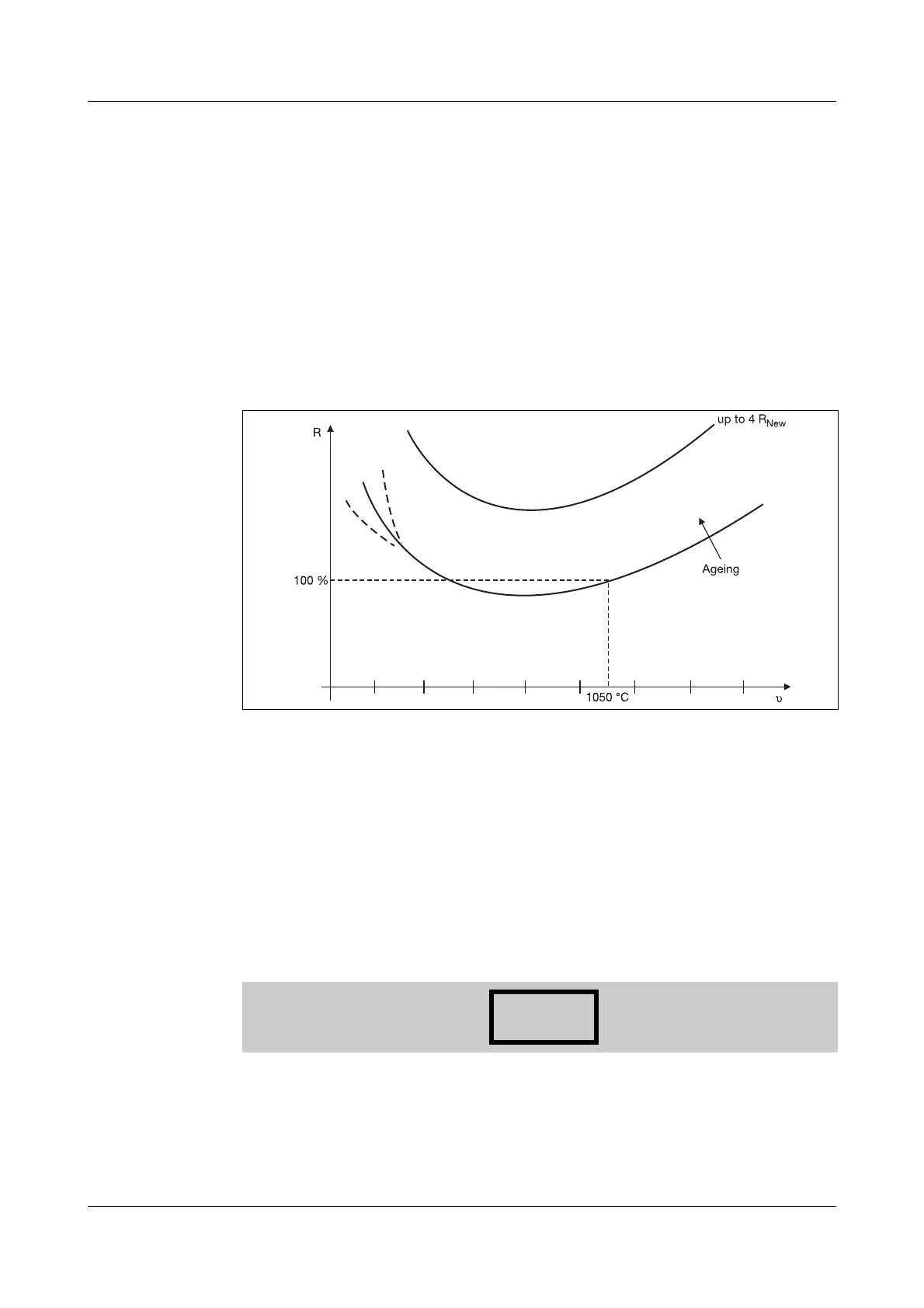
(Figure 4).
Figure 4: Resistance changes for silicon carbide
Silicon carbide heating elements have a nominal resistance that can alter by a
factor of 4 over the long term. So when dimensioning a system, it is necessary
to provide power controllers that can produce twice the (nominal) power for
the heating elements.
This results in double the current for the SCR power controller.
Old Ⳏ old condition of the heating element RNew =
New Ⳏ new condition of the heating element
The relationship is illustrated by the following formula:
P control is also used for free-running economy circuits running off a 3-phase
supply network.
P
New
U
New
I
New
U
Old
2
-----------
2I
Old
U
Old
I
Old
P
Old
====
(12)


 To Next Page