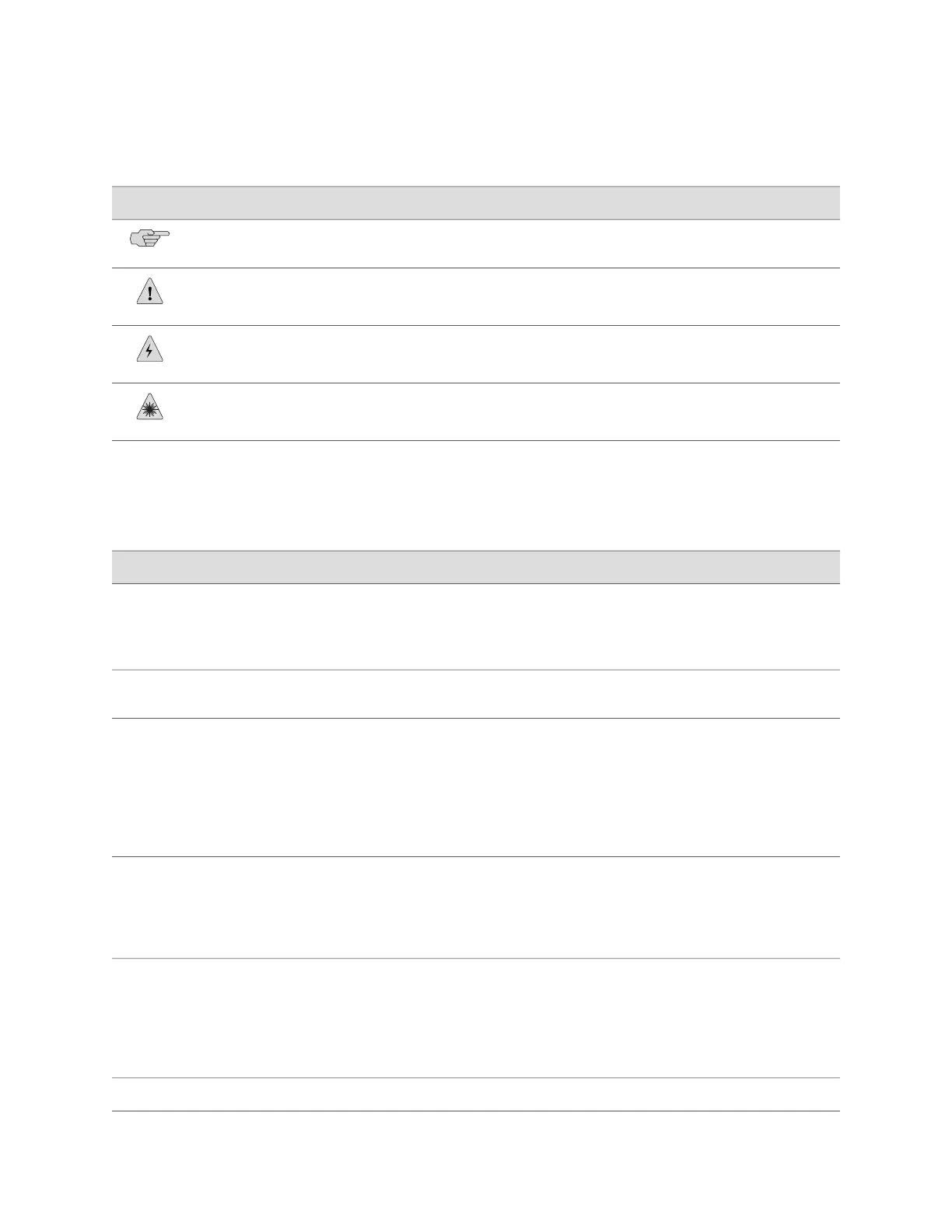
Table 1: Notice Icons
DescriptionMeaningIcon
Indicates important features or instructions.Informational note
Indicates a situation that might result in loss of data or hardware damage.Caution
Alerts you to the risk of personal injury or death.Warning
Alerts you to the risk of personal injury from a laser.Laser warning
Table 2 on page xiv defines the text and syntax conventions used in this guide.
Table 2: Text and Syntax Conventions
ExamplesDescriptionConvention
To enter configuration mode, type the
configure command:
user@host> configure
Represents text that you type.
Bold text like this
user@host> show chassis alarms
No alarms currently active
Represents output that appears on the
terminal screen.
Fixed-width text like this
■
A policy term is a named structure
that defines match conditions and
actions.
■
JUNOS System Basics Configuration
Guide
■
RFC 1997, BGP Communities
Attribute
■
Introduces important new terms.
■
Identifies book names.
■
Identifies RFC and Internet draft
titles.
Italic text like this
Configure the machine’s domain name:
[edit]
root@# set system domain-name
domain-name
Represents variables (options for which
you substitute a value) in commands or
configuration statements.
Italic text like this
■
To configure a stub area, include
the stub statement at the [edit
protocols ospf area area-id]
hierarchy level.
■
The console port is labeled
CONSOLE.
Represents names of configuration
statements, commands, files, and
directories; IP addresses; configuration
hierarchy levels; or labels on routing
platform components.
Plain text like this
stub <default-metric metric>;
Enclose optional keywords or variables.< > (angle brackets)
xiv ■ Documentation Conventions
SRX100 Services Gateway Hardware Guide


 To Next Page