Chapter 11 Alarm and Troubleshooting
11.1 Alarm Messages
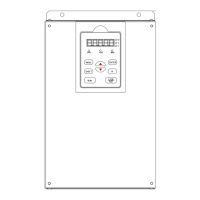
Digital flickering on the display indicates that an alarm occurs indicating that the driver is faulty. For
details about faults, see Table 11-1 “Fault codes”. A code of the alarm message is represented by a
hexadecimal data, and four numeric displays appear. If the driver is faulty, the corresponding bits in the alarm
codes are set to “1”. For example, if an encoder is not connected, the 1
st
and 2
nd
bits of the faulty code are set
to “1”. As a result, “0006” is displayed.
Table 11-1 Fault codes
A maximum of 7 generated alarms can be stored in the driver. For details, enter the menu of Group F007.
Press Enter. The interface of faulty codes is displayed. The errors that you first discovered are those that
have occurred most recently. Press ▲ or ▼ to browse the messages of historical alarms. If the decimal point
at the lower right corner in the second bit of the numeric display is on, it indicates that the earliest alarm
message is just browsed; if the decimal point at the lower right corner in the third bit of the numeric display is
on, it indicates that the latest alarm message is just browsed.
For details on error messages, you need to access PC software via a communication port to check the
working status of the driver when an error occurs. Here are some messages of the driver for your reference:
1. Error codes;
2. Bus voltage when an error occurs;
3. Motor speed when an error occurs;
4. Motor current when an error occurs;
5. Driver temperature when an error occurs;
6. Working mode of the driver when an error occurs;
7. Accumulated working time of the driver when an error occurs;

 To Next Page
 Loading...