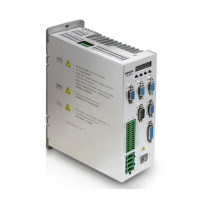
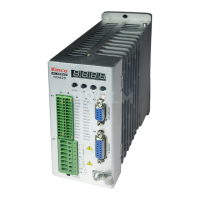
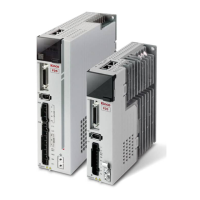
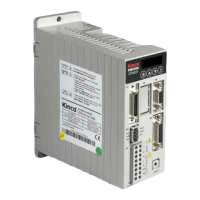
Kinco JD Series Servo User Manual
motor parameters
10 : Initialzie all control parameters
except motor parameters
Station No. of Drivers
Note: To change this parameter, you
need to save it with the address “d5.00”,
and restart it later.
Set the baud rate of RS232 port
540 19200
270 38400
90 115200
Note: To change this parameter, you
need to save it with the address “d5.00”,
and restarts it later.
0:1:1
1:1:N
Note:It needs to restart driver after
changing
this parameter.
Data bit = 8
Stop bit = 1
Parity = None
10.1.3 Transport Protocol
The RS-232C communication of the JD servo driver strictly follows a master/slave protocol. The host
computer can send any data to JD driver. The driver configured with ID No. will calculate such data and return
a reply.
This transport protocol of RS232 uses a data packet with fixed length of10 bytes.
ID CHKS8 byte data
byte 0 byte 9
ID is the ID No. of the slave
CHKS = - SUM(byte0,…,byte8), CHKS is the lowest byte of the calculation result.
The host sends:
ID CHKS8 byte host data
byte 0 byte 9
When D5.15 is 0,JD servo sends:
ID CHKS8 byte slave data
byte 0 byte 9
When D5.15 is 1,JD servo sends:
ID CHKS8 byte host data
byte 0 byte 9
ID CHKS8 byte slave data
byte 0 byte 9
Note: Each 10-byte packet has its own CHKS.
If the host sends an ID not existed in the network to the JD servo driver, no JD servo driver will make a reply.
After the host sends the data correctly, the slave will find the data packets in compliance with its own ID and
check the CHKS value. If the checksum does not match, the slave will not make a response.


 To Next Page
 Loading...