WRS – Installation Manual
2. Manual planning
When installing a system on equipment where other radio systems are already in place, it is important to take
the following factors into consideration.
A. Wi-Fi
®
The PC wireless network is the most commonly used system and, as a class 1 device, it is capable of
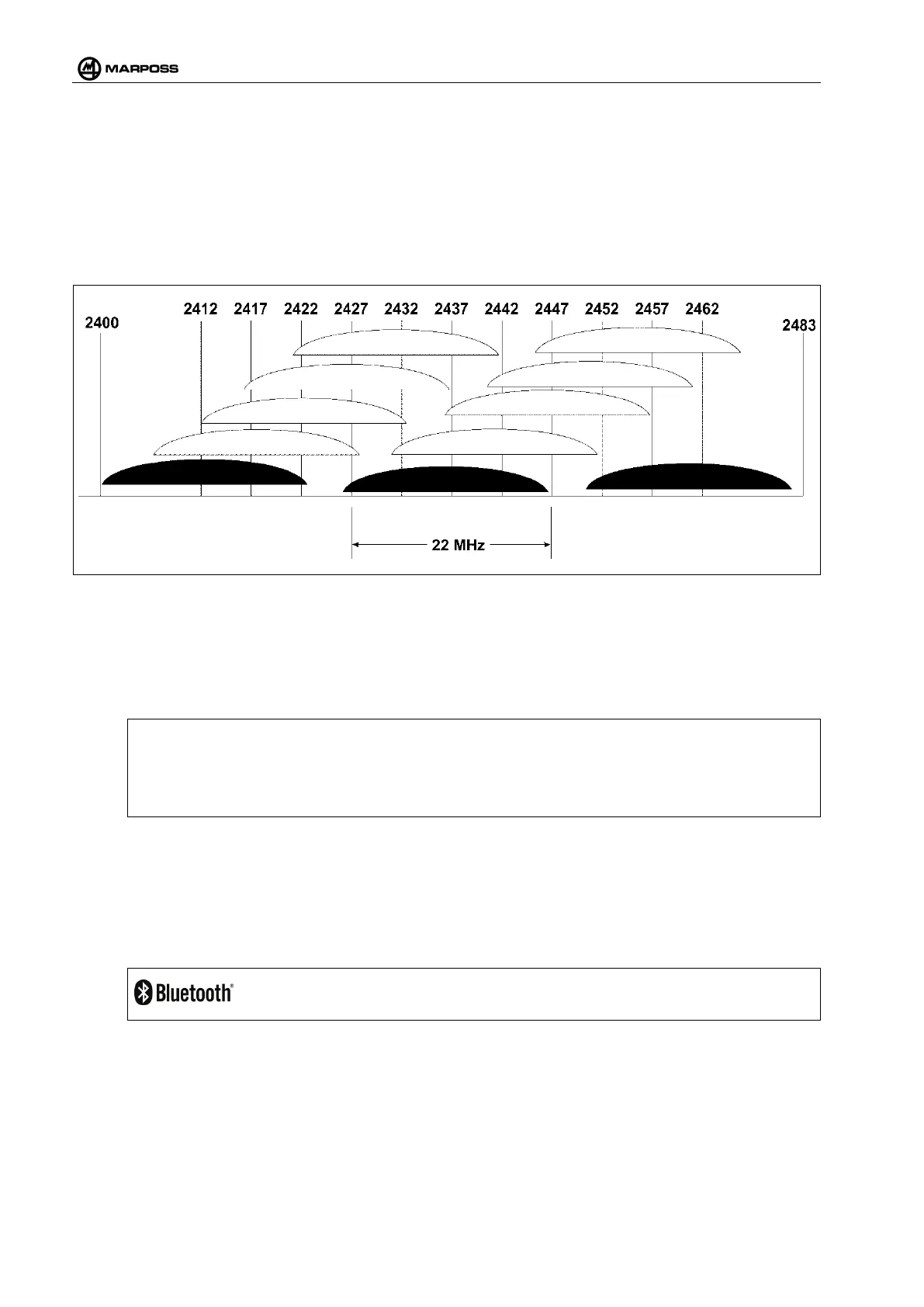
transmitting more power than other systems (+ 20 dBm, ~100 mW). Its typical frequency usage is shown
below.
Figure 4-36. Wi-Fi
®
channels.
Each coloured area corresponds to a different set of superimposed channels; naturally a single set must be
used for each area, the ones highlighted in black are the most commonly used. The generic “Wi-Fi
®
” name
covers a range of different standards; the new, faster communication networks can interfere significantly with
the WRS system, hence it is advisable to select channels at the limits of the occupied band in each zone.
[
N.B.:
Example of the rule that should be followed in these types of installation:
“n” and the other to channel “n + 20” when a Wi-Fi
®
system is present; assuming an initial
bandwidth of 20 MHz, in this way on WRS will be positioned “to the left” of the Wi-Fi
®
channel, and
the other “to the right”.
B. Bluetooth
®
Wireless
This system has frequency and modulation characteristics that are very similar to WRS: both feature seventy
nine 1 MHz bandwidth channels and a typical output power level of +4 dBm (~2,5mW). It uses the FHSS
(Frequency Hopping Spread Spectrum) in order to minimise the effect of interference from other systems. In
this standard, all the channels are used in turn, “hopping" from one channel to another at random. Devices
that use Bluetooth
®
wireless technology do not represent significant sources of interference.
The Bluetooth
®
mark and logo are registered trademarks of the Bluetooth SIG, Inc.
and are used under license by MARPOSS.
C. Andon
™
This system is used for wireless monitoring on OMRON
®
manufactured machines and features the following
specifications:
• 67 channels in the frequency range 2401 MHz – 2480.2 MHz;
• Modulation in DSSS format;
• Equivalent output power 10 mW/MHz.



 To Next Page